


Search investment and measurable growth
SEO vs Google Ads Sri Lanka is often treated as a simple contest: one channel must be better and the other must be wasteful. I do not see it that way. Paid search buys immediate access to existing demand, while organic search builds an asset that can continue attracting buyers after the initial work has been completed.
By Sampath Liyanage
The question I hear from business owners is usually framed like this: “Should I put LKR 100,000 a month into Google Ads or into SEO?” The honest answer depends on when the leads are needed, how long the company can invest, how expensive the market is, what the website currently looks like and whether the business can convert the traffic it receives.
Paid search can generate enquiries from the first month because the business is paying to appear for selected searches. SEO usually starts more slowly because the site must earn visibility through technical improvements, useful pages, authority and time. The mistake is comparing the first month of one channel with the long-term value of the other.
A better comparison covers a full year. It looks at the speed of results, total cost, cost per qualified lead, the quality of the website created during the process and what remains after the monthly spending stops. This wider view reflects the changing digital marketing environment in Sri Lanka.
Direct answer
Which channel normally delivers the better return?
Google Ads is usually stronger when a business needs demand immediately, wants to test an offer or must support a short campaign. SEO is usually stronger when the same products or services will be sold for years and the business wants its cost per organic lead to decline as visibility compounds. A blended approach often delivers the most balanced result: paid search supplies early demand while SEO develops the owned search presence.
The Question Every Owner Asks Wrong
The false choice is asking which channel is universally better. The more useful question is: “Which channel fits the job I need completed during the next twelve months?”
Imagine a new Colombo service company that has no search visibility and needs enquiries this week. Telling that company to wait several months for organic growth is not practical. Paid search may be the correct starting point. Now imagine an established company that has been paying for the same commercial searches every month for five years. Depending entirely on advertising may be hiding an expensive organic gap.
This is why I separate speed from efficiency. Ads can win the speed test in months one to three. Organic search can become increasingly efficient after the initial foundation begins producing visibility. Neither result is automatic. A weak campaign can waste money in either channel.
The website also matters. Paid campaigns often reveal conversion problems quickly. If hundreds of relevant visitors arrive but nobody calls, the issue may be the offer, trust, price, page speed or enquiry process. SEO cannot fix a weak business proposition, and advertising cannot permanently compensate for a website customers do not trust.
SEO vs Google Ads Sri Lanka: The 12-Month Maths in Rupees
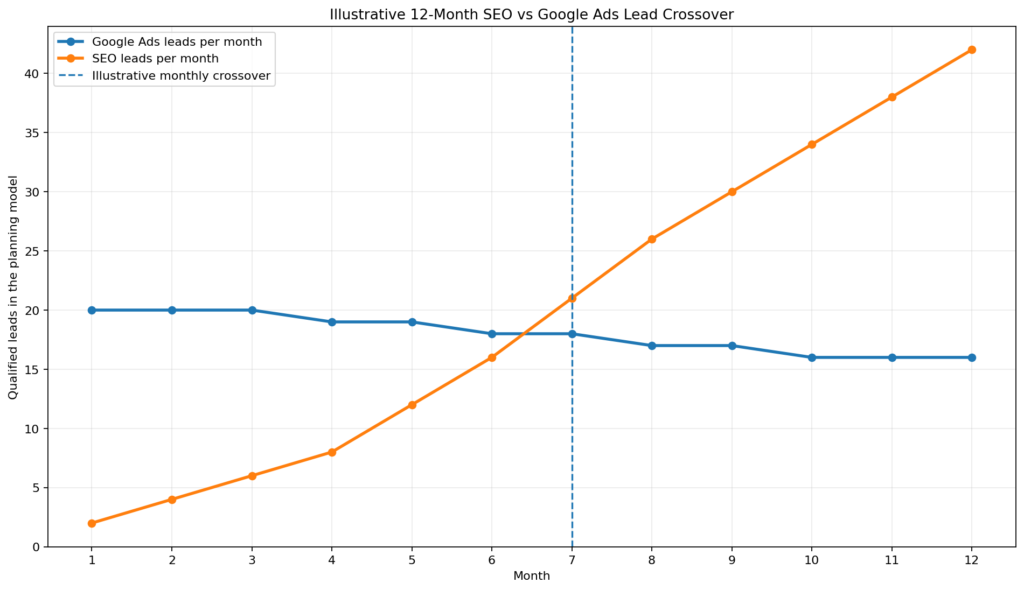
To compare the channels fairly, I use the same monthly investment for each: LKR 100,000. The following figures are an illustrative planning model, not a national benchmark, quotation or promise. They show how a crossover can happen when paid leads remain relatively stable while organic leads grow as the website gains useful pages and visibility.
Planning assumptions
- Each channel receives LKR 100,000 every month.
- A “lead” means a qualified call, form or enquiry—not a website visit.
- Paid lead volume begins immediately but softens slightly as competition and efficiency change.
- Organic lead volume begins slowly and increases as technical, content and authority work matures.
- Actual outcomes vary by sector, website, location, competition, sales process and implementation quality.
| Month | Ads leads | Ads cost per lead | SEO leads | SEO cost per lead |
|---|---|---|---|---|
| 1 | 20 | LKR 5,000 | 2 | LKR 50,000 |
| 2 | 20 | LKR 5,000 | 4 | LKR 25,000 |
| 3 | 20 | LKR 5,000 | 6 | LKR 16,667 |
| 4 | 19 | LKR 5,263 | 8 | LKR 12,500 |
| 5 | 19 | LKR 5,263 | 12 | LKR 8,333 |
| 6 | 18 | LKR 5,556 | 16 | LKR 6,250 |
| 7 | 18 | LKR 5,556 | 21 | LKR 4,762 |
| 8 | 17 | LKR 5,882 | 26 | LKR 3,846 |
| 9 | 17 | LKR 5,882 | 30 | LKR 3,333 |
| 10 | 16 | LKR 6,250 | 34 | LKR 2,941 |
| 11 | 16 | LKR 6,250 | 38 | LKR 2,632 |
| 12 | 16 | LKR 6,250 | 42 | LKR 2,381 |
In this model, monthly organic leads move ahead of paid leads in month seven. Cumulative organic leads remain behind until the final month because paid search created a strong early advantage. At the end of twelve months, the advertising model has produced 216 leads, while the organic model has produced 239 leads. Each channel has received LKR 1.2 million.
The chart also explains why companies become impatient. Organic work can appear expensive during the first months because the site is still being repaired, expanded and understood. Cost per lead improves only after those assets begin producing enquiries. Stopping in month four can mean paying for the foundation but abandoning the compounding phase.
| Approach | Best use | Main trade-off |
|---|---|---|
| Google Ads | Immediate demand, launches, testing and seasonal campaigns. | Traffic normally falls when the media budget stops. |
| SEO | Recurring searches, high-value services and long-term demand. | Results usually take longer and depend on sustained implementation. |
| Blended | Businesses that need leads now while building an owned search asset. | Requires disciplined measurement and clear budget allocation. |
When Paid Search Is the Right Call
Paid search is the right tool when timing matters more than compounding. A campaign can be launched, measured and adjusted quickly. That makes it valuable for testing whether demand exists before committing to a larger content or website programme.
A new property project in Colombo
A developer releasing a limited number of apartments cannot wait indefinitely for organic visibility. The project has a launch window, a defined location and a sales team ready to follow up. Paid search can reach people actively researching apartments in the relevant area while the project pages, content and organic authority are still developing.
A seasonal travel offer
A hotel or tour operator may have unsold capacity for a specific period. Advertising can support the offer immediately, target selected markets and stop when the available inventory has been filled. Building a permanent page may still help, but the urgent commercial problem belongs to paid media.
Paid search is also useful for testing language. If one advertisement and landing page consistently produce better enquiries, the company has learned something valuable about customer priorities. That insight can improve the wider digital marketing strategy, organic pages and sales material.
The paid-search conditions I check
- The offer is clear and commercially viable.
- The landing page matches the advertisement.
- Calls, forms and sales are tracked.
- Someone can respond quickly to enquiries.
- Negative keywords and location targeting are reviewed.
- The business knows its acceptable acquisition cost.
Without these controls, the discussion about google ads cost sri lanka becomes misleading. A low cost per click is not valuable when the clicks are irrelevant, and an expensive click can still be profitable when it leads to a high-value sale.
When SEO Is the Right Call
SEO becomes more attractive when buyers search for the same service repeatedly and the company expects to remain in that market. Professional services, education, healthcare providers, logistics, tourism, software and ecommerce often have recurring demand that can justify building permanent visibility.
I become especially concerned when a company has paid for the same commercial terms for years but has no useful organic landing pages. Advertising may be producing leads, but it is also masking the fact that the business owns very little visibility. The company has data showing which terms convert, yet none of that knowledge has been turned into durable content.
A proper organic programme should not simply publish articles. It should improve the technical website, service architecture, local information, internal linking, expertise signals and conversion path. The investment creates assets: better pages, clearer information, stronger measurement and a more useful website.
Budget also needs to match the work. A company evaluating SEO optimisation packages should look beyond the number of keywords or monthly articles. The package must address the actual barriers preventing the site from competing.
The organic-search conditions I check
- The product or service has recurring search demand.
- The company can invest for more than a few weeks.
- The website can be improved technically and editorially.
- The business can provide real expertise, evidence and useful information.
- Commercial actions can be measured.
- Decision-makers understand that rankings are not guaranteed.
The Blended Budget by Business Stage
I rarely recommend the same split to every company. The correct balance depends on maturity, cash flow and urgency. The percentages below are planning starting points, not fixed rules.
| Business stage | Paid search | SEO | Reasoning |
|---|---|---|---|
| Startup or new offer | 70% | 30% | Test demand and messaging while fixing the website foundation. |
| Growing business | 45% | 55% | Maintain lead flow while shifting more investment into owned visibility. |
| Established brand | 30% | 70% | Protect brand demand, expand category coverage and reduce dependency on paid traffic. |
The growing-business stage is where measurement becomes especially important. Management needs a practical view of digital marketing roi sri lanka: not only how many leads each channel generated, but also which leads became customers, their average value and the time required to close them.
How to Measure the Channels Fairly
Paid and organic search reports often use different language. One report focuses on clicks and conversions; the other focuses on rankings, impressions and traffic. A business cannot compare the channels until both are connected to the same commercial outcomes.
I use five common measures:
- Qualified leads: enquiries that match the service, location and customer criteria.
- Cost per qualified lead: total channel investment divided by qualified leads.
- Lead-to-sale rate: the percentage of qualified leads that become customers.
- Customer acquisition cost: channel investment divided by new customers.
- Revenue or margin contribution: the commercial value attributable to the channel.
I also separate brand searches from non-brand searches. A person searching the company name may have discovered the business through another channel. Treating every branded click as new demand can exaggerate both paid and organic performance.
A credible reporting process should also explain uncertainty. Customers move between devices, ask colleagues, see social posts and return later. Attribution is useful, but it is not perfect. The objective is to make better decisions, not to claim that one dashboard captures every influence.
How AI-Assisted Search Changes the Comparison
AI-assisted search adds another reason to invest in useful owned information. Buyers increasingly ask detailed questions rather than typing only two or three words. A strong website can explain services, suitability, process, locations and evidence in a form that supports traditional results and newer answer-based experiences.
That does not make paid search irrelevant. Advertising can still place an offer in front of active demand. The difference is that the organic asset now supports more than a conventional list of blue links. Clear, attributable information can also strengthen discovery when search systems assemble direct answers.
The practical response is not to create a separate layer of artificial “AI content.” Businesses should publish accurate pages that answer real questions, name the responsible experts, show evidence and remain technically accessible. These are the same qualities required for AI-supported digital growth.
The Most Expensive Mistake: Stopping When SEO Starts Working
The most expensive mistake is cutting organic investment the moment early results appear. Management sees improving rankings and assumes the work is finished. Content production stops, technical monitoring disappears and competitors continue improving.
SEO does not need to remain at the same intensity forever. Once the foundation is strong, the work can shift toward maintenance, selected growth opportunities and conversion improvement. But abandoning the channel completely can allow important pages to become outdated and technical problems to accumulate.
The equivalent mistake in paid search is leaving campaigns on autopilot. Search terms change, competitors enter, landing pages become outdated and sales teams fail to report lead quality. Both channels require management; they simply create value in different ways.
My practical conclusion: use paid search to buy speed and controlled experiments. Use SEO to build the permanent pages, authority and information that reduce long-term dependency on rented traffic. Measure both against qualified business outcomes.
Frequently Asked Questions
Is SEO cheaper than Google Ads?
Not necessarily during the first months. SEO can require substantial technical, content and authority investment before producing leads. It may become more cost-efficient over time when useful pages continue attracting qualified visitors.
How quickly can Google Ads generate leads?
A campaign can begin generating traffic immediately after approval, but profitable lead generation depends on targeting, competition, landing-page quality, tracking and follow-up.
Should a new business start with ads or SEO?
A new business often benefits from paid search for early demand testing while it builds the technical and content foundation required for organic visibility.
Can SEO replace paid advertising completely?
Sometimes, but not in every situation. Paid campaigns remain useful for launches, short offers, testing and areas where organic visibility is still developing.
What should be measured first?
Start with qualified leads, sales, acquisition cost and revenue or margin contribution. Traffic and rankings help diagnose performance but do not replace commercial measurement.
How should a business choose outside SEO support?
Compare the proposed scope with the website’s actual problems, ask how leads and sales will be measured, confirm account ownership and avoid guaranteed ranking claims. Xplana also provides a broader guide to understanding SEO specialist support.

SEO, analytics and AI-search visibility
About the Author
Sampath Liyanage is an SEO Specialist Sri Lanka professional and the founder of SEO Sri Lanka. He works with local and international businesses on technical SEO, content strategy, local search, ecommerce optimisation, international targeting, authority development and performance measurement.
His approach connects rankings and traffic with qualified enquiries, customer acquisition and revenue. He also helps organisations structure clear, attributable information for traditional search and emerging AI-assisted discovery.
He has worked across tourism, ecommerce and professional-service markets in Sri Lanka and internationally.