The political landscape of the island nation entered a new phase in May 2025. Recent local government polls have reshuffled the deck of political fortunes across the country.
These outcomes have applied unexpected pressure on the main rival parties. Both the Samagi Jana Balawegaya (SJB) and the Sri Lanka Podujana Peramuna (SLPP) now face complex dilemmas.
This analysis focuses on the electoral setback for the ruling National People’s Power (NPP). It also explores the new opportunities for opposition forces. The context is shaped by recent history, including the severe economic crisis and the 2022 Aragalaya protests.
A new axis of political polarization has emerged from these votes. It frames the debate as ‘liars versus thieves,’ moving beyond older ethnic divisions.
The local elections served as a critical mid-term referendum. They tested the NPP government, which won a landslide victory in the 2024 national elections.
Key figures like President Anura Kumara Dissanayake, opposition leader Sajith Premadasa, and SLPP organizer Namal Rajapaksa are central to this shifting dynamic. The Sri Lankan government under President Dissanayake, which took power in the wake of the turmoil that began in April 2022, is now under closer scrutiny.
In conclusion, the local election results have compelled all major parties to re-evaluate their public narratives and coalition-building approaches. The pressure is on for a strategic reset.
The 2025 Local Elections: A Political Watershed for Sri Lanka
Data from the May 2025 local government elections reveals a significant recalibration of political support. These polls served as the first major electoral test since the national vote in late 2024.
The outcomes provide a detailed map of current public sentiment. They mark a definitive moment in the nation’s ongoing political realignment.
Key Results and Vote Shares
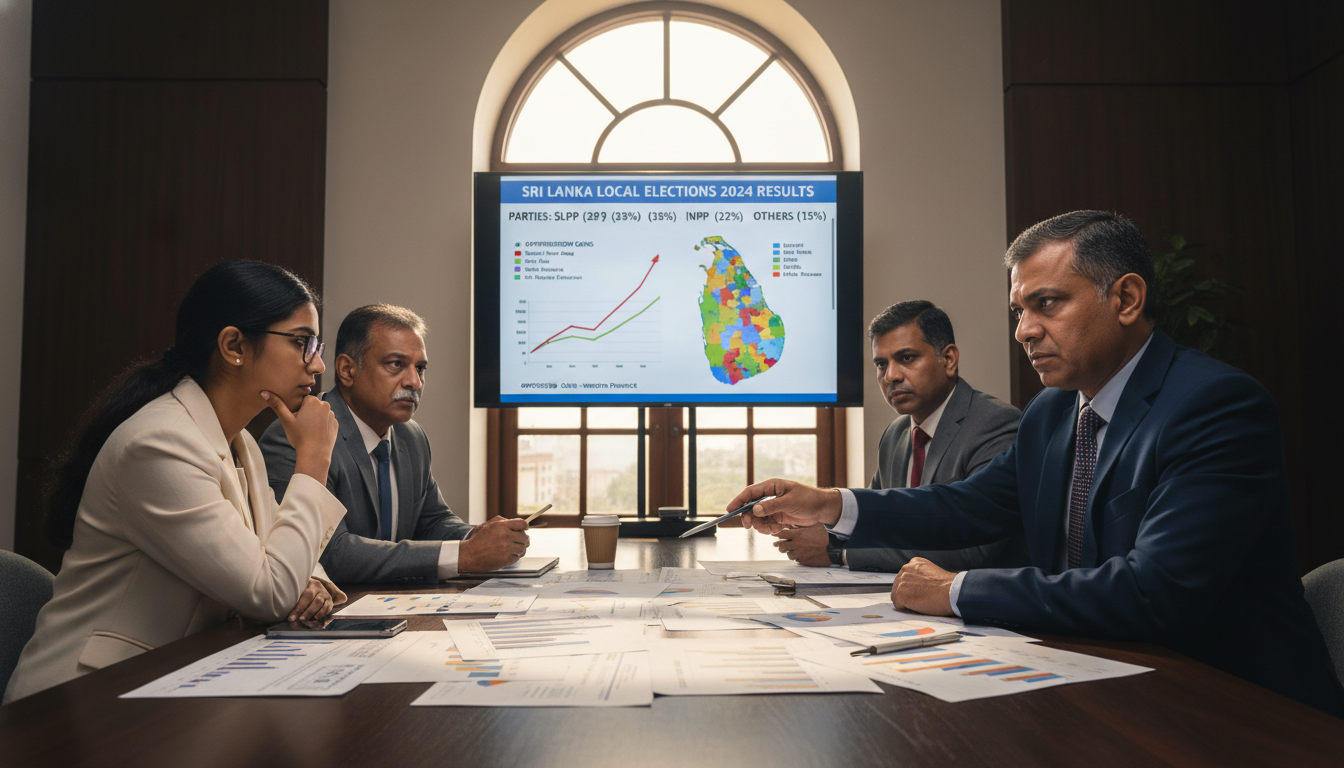
The National People’s Power (NPP) emerged with control of most local councils. The party secured a nominal majority in 265 out of 339 local government bodies.
This translated to 3,926 elected members across the island. However, the NPP’s national vote share stood at 43%.
A nominal majority means the party lacks an absolute majority in many councils. This forces it to seek alliances with smaller groups to pass budgets and enact policies.
The main opposition, the Samagi Jana Balawegaya (SJB), captured 21% of the total vote. The Sri Lanka Podujana Peramuna (SLPP) followed with 9%.
This fragmentation illustrates the divided state of the opposition bloc. It presents a complex challenge for any unified front against the ruling party.
In the Northern and Eastern provinces, the Ilankai Tamil Arasu Kachchi (ITAK) made a strong comeback. The Tamil nationalist party won clear majorities in 35 local bodies.
Smaller parties, including Muslim Congress groups and up-country Tamil parties, also secured representation. Their presence adds another layer to local governance negotiations.
Comparison with 2024 National Elections
The local election results show a notable cooling of support for the ruling party. The NPP’s 43% vote represents an almost 20-point decrease from its performance in the November 2024 general election.
That earlier vote was a landslide victory for President Anura Kumara Dissanayake and his national people power coalition. The contrast between the two results is stark.
It suggests the intense public optimism that followed the 2024 win has moderated. Voters used the local polls to express more measured judgments on delivery and governance.
The decline is particularly significant given the context. The current administration took power promising urgent economic recovery after the severe economic crisis that began in April 2022.
For the Sri Lankan opposition, the numbers are a mixed signal. The SJB’s 21% share is stable but not growing, while the SLPP’s 9% indicates a base that has not fully collapsed.
Together, these results complete a political watershed that began with the 2024 national polls. The era of single-party dominance at all levels of government has clearly ended.
The local elections have set a new, more competitive baseline for politics. All parties must now operate in a landscape where compromise and coalition-building are essential.
How Sri Lanka’s Opposition Faces Fresh Pressure After Local Election Results
The immediate aftermath of the May 2025 polls triggered a wave of introspection and urgent recalibration among the nation’s opposition forces. These groups now operate under a dual mandate: to hold the government accountable and to prove their own relevance to a skeptical electorate.
Immediate Repercussions for Opposition Parties
In the days following the verdict, internal leadership reviews began within major parties. Public statements from senior figures reflected a mix of defiance and acknowledgment of the tough road ahead.
Strategic recalibrations are now essential. The campaign showed how previously delegitimized parties regrouped. They galvanized the other pole of the new political axis.
This strategy exploited the gap between the ruling party’s tall promises and actual delivery. It successfully framed the narrative around “lies and trickery.” This united opposition message gained significant traction with voters across the island.
For the traditional opposition, the pressure is to convert this narrative success into tangible political gains. This involves difficult choices about alliances and grassroots mobilization.
Media and Public Discourse Shifts
The media focus has moved distinctly. Initial coverage of the government’s anti-corruption crusade has been replaced. Now, reports highlight perceived policy failures and unfulfilled promises.
The “liars versus thieves” framework has become a powerful tool. It allows a diverse opposition to counter the ruling party’s moral high ground. This simple dichotomy resonates in everyday public conversation.
Social media, once a domain dominated by pro-government voices, now hosts a fiercer debate. The administration’s first six months were marked by rapid responses to online issues. The local election results have checked this tendency, emboldening critics.
Specific incidents have fueled this shift. The handling of a schoolchild assault case in Kotahena was cited repeatedly. It became a symbol for critics arguing that the state’s security forces and cabinet ministers were out of touch.
A damaging perception has taken root: that the ruling party is uddachcha, or conceited. This characterization strikes directly at its “people’s government” image. It opens the administration to criticism from civil society and trade unions.
Key questions now define the political scene:
- Has the opposition’s unity in narrative led to practical cooperation?
- Can these parties present a coherent alternative on economic reforms and human rights?
- Will scrutiny extend to international forums, like the human rights council?
The collective opposition remains a fragmented collection of parties. They share a common adversary but lack a unified platform for economic recovery. The legacy of the economic crisis that intensified in April 2022 still dictates voter priorities.
Analysts note that the Janatha Vimukthi Peramuna (JVP) history within the ruling coalition adds complexity. The current pressures are a natural consequence of electoral dynamics. Voters are comparing grand promises against the challenging Sri Lanka economic reality, a topic explored in the recent economic outlook.
For Sri Lankans, the discourse is no longer about past allegiances. It is firmly fixed on the present capacity to deliver a stable future.
National People’s Power: From Landslide Victory to Local Setback
The electoral setback for the National People’s Power (NPP) coalition revealed the complexities of transitioning from campaign rhetoric to actual governance. Its reduced mandate indicates growing voter impatience with the time taken to deliver on sweeping promises.
This shift presents a fundamental test for the administration of President Anura Kumara Dissanayake. The coalition must now navigate the practical constraints of governing.
NPP’s Performance in Local Government Bodies
While securing a nominal majority in most councils, the NPP’s performance was regionally mixed. Its strength remained in traditional strongholds, but support was softer in urban and multi-ethnic areas.
The result of 265 councils without absolute control is a significant operational shift. It forces the party to seek alliances with smaller groups to pass local budgets and enact policies.
This necessity for coalition-building marks a departure from its stance of political purity. It is a direct test of the NPP’s pragmatic governance capabilities at the grassroots level.
The role of the party’s core network, historically associated with the Janatha Vimukthi Peramuna (JVP), was crucial in local electoral mechanics. This base provided organizational muscle but faced a more fragmented political field.
Challenges in Delivering Campaign Promises
The core dilemma lies in matching high expectations with economic reality. Grand pledges of a digital revolution and rapid mineral value-addition have collided with slower-than-anticipated economic recovery.
Growth projections have been revised down from 5% to 3.5%. This slowdown has limited the government’s fiscal space for dramatic interventions.
In practice, the Sri Lankan government has largely continued the previous administration’s IMF program. The February budget offered lowered taxes and higher state sector salaries, but it did not fully meet public hopes for immediate relief.
A gap has emerged between the rhetoric of *’system change’* and policy continuity. The government’s strong anti-corruption discourse, while popular, has sometimes obscured deeper structural challenges.
Critical issues like debt sustainability and state-owned enterprise (SOE) reform require complex, long-term solutions. These are less visible than high-profile arrests but are central to the nation’s Sri Lanka economic health.
Institutions like the Central Bank continue to operate within established frameworks. This continuity underscores the difficulty of implementing radical economic reforms overnight.
The local election serves as a stark reality check. It may compel the ruling national people power coalition to transition from a ‘permanent campaign mode’ to a more established, and perhaps more pragmatic, governing posture.
Samagi Jana Balawegaya: The Opposition Leader’s Dilemma
The 21% vote share captured by the Samagi Jana Balawegaya (SJB) defines its current political standing and its central strategic challenge. The party solidified its position as the primary rival to the ruling coalition.
Yet, this runner-up status creates a difficult paradox. It is strong enough to lead the opposition bloc but too weak to realistically form a government alone.
This places SJB leader Sajith Premadasa in a complex bind. His party must now choose a path that either expands its appeal or solidifies its control over a fragmented political field.
SJB’s Vote Share and Strategic Positioning
The 21% result indicates a stable, but seemingly capped, core of support. It reflects a constituency disillusioned with both the current sri lankan government and the older political families.
For the samagi jana balawegaya, this creates the dilemma of being a ‘government-in-waiting’ without a clear route to a parliamentary majority. National victory would require nearly doubling its vote share, a monumental task.
Two broad strategic options are available. The first is to consolidate its leadership by weakening other opposition rivals, like the SLPP and the UNP.
This path aims to absorb their disaffected voters. The second, more difficult option is to build a broad anti-government coalition with those same rivals.
Each choice carries significant risk. Consolidation could take years and might fail. Coalition-building risks blurring the party’s identity and message.
Coalition-Building Challenges
Premadasa’s post-election statement highlighted the coalition path. He declared the SJB was “prepared to take the lead in uniting all Opposition forces.”
The feasibility of this call is immediately tested by history and ideology. The most logical ally, the United National Party (UNP), is its parent party.
Past talks between them have repeatedly collapsed over leadership and strategy. This historical tension remains a major obstacle.
Forming a pact with the Sri Lanka Podujana Peramuna (SLPP) seems even less likely. The SJB’s foundation was built in opposition to the Rajapaksa-era policies linked to the economic crisis that erupted in april 2022.

Aligning with the SLPP would contradict this core identity. It could alienate the party’s base and civil society supporters focused on human rights and accountability.
There is a profound brand risk. Partnering with parties the NPP labels as the “old guard” could validate the ruling party’s narrative. It would paint the SJB as part of the very system it claims to oppose.
The fundamental, long-term task for the samagi jana balawegaya is therefore narrative-building. It must move beyond criticizing the incumbent’s failures.
The party needs a compelling alternative vision for debt sustainability, the role of the central bank, and economic management. Without this, its claim to lead remains purely arithmetic, not visionary.
Sri Lanka Podujana Peramuna: The Unexpected Resurgence
The Sri Lanka Podujana Peramuna (SLPP) staged a notable recovery in the May local polls. Its vote share climbed to nearly 10%, defying expectations after a collapse in 2024. This rebound is attributed to a strong grassroots mechanism, a legacy of its political ancestry.
Under Namal Rajapaksa, the party mobilized conservative voters with rhetoric around national sovereignty. Campaigns invoked historical events and alleged the ruling party was soft on separatism. Criticism of the Sri Lankan government‘s defense agreements featured prominently.
Limitations exist for this resurgence. Ideological overlap with the NPP and the difficulty of reclaiming lost voters are hurdles. The party must move beyond familiar nationalist themes tied to the civil war.
The SLPP’s ambiguous coalition stance reflects its niche strategy. It emerges as a revived third force, altering opposition politics but not posing an immediate national threat. The legacy of the economic crisis that began in April 2022 continues to shape voter priorities.