The 2025 poll for local authorities has delivered a decisive outcome. The National People’s Power (NPP) achieved a historic and commanding triumph.
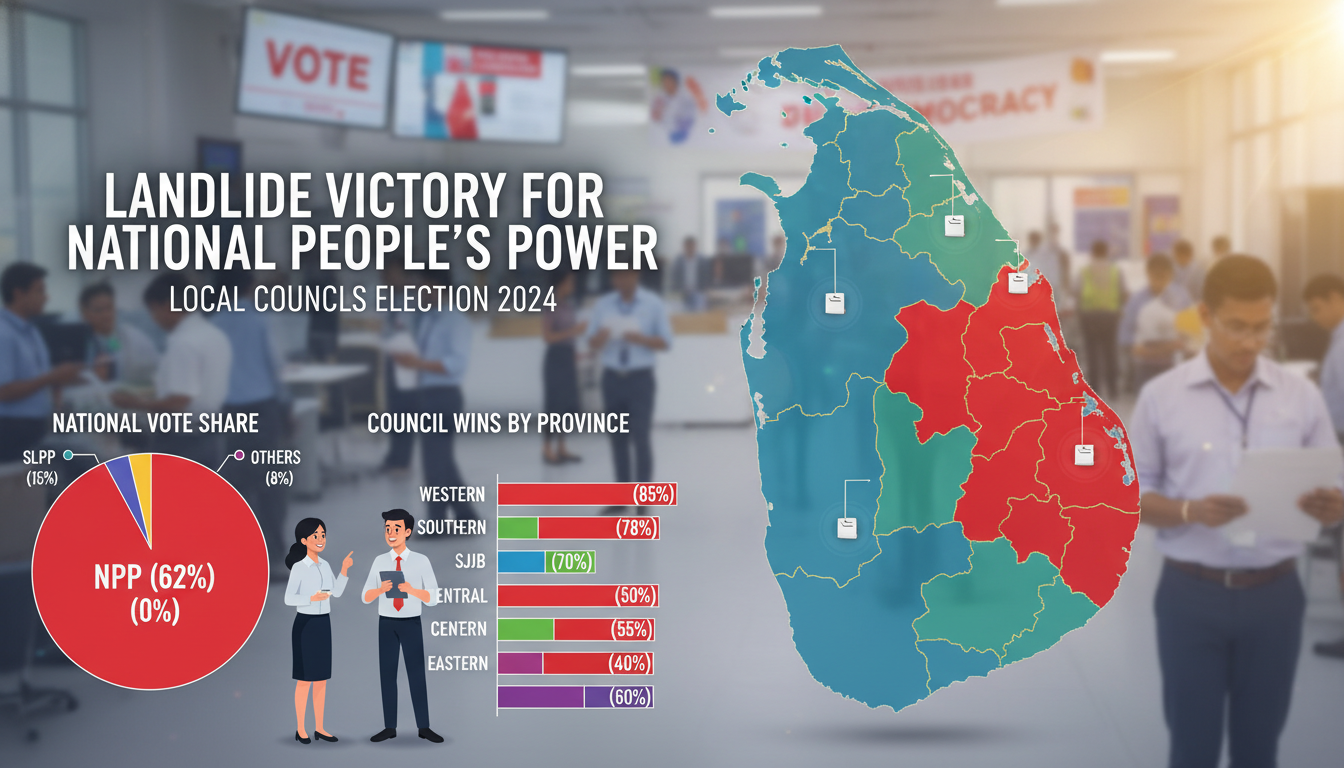
Final results show the NPP secured control of 265 Local Government Institutions. The party won 3,927 seats at the grassroots level.
It garnered 4,503,930 votes, representing 43.26% of the total ballots cast. This marks a significant shift in the nation’s political landscape.
The Samagi Jana Balawegaya (SJB) finished second. They obtained 1,767 seats with 2,258,480 votes, or 21.7% of the share.
The Sri Lanka Podujana Peramuna (SLPP) won 742 seats. Their vote count was 954,517, which is 9.2% of the total.
The United National Party (UNP) gained 381 seats. They received 488,406 votes, amounting to 4.7%.
Public participation saw a turnout of just under 62%. This figure provides context for the delayed electoral process.
This introduction presents the authoritative, factual results as officially reported. It sets a neutral tone for the detailed analysis to follow.
A Historic Mandate at the Grassroots
Voters have delivered a strong, yet complex, verdict in the most recent contest for community leadership. The numbers paint a picture of clear preference mixed with a fragmented political landscape.
This outcome grants one group undeniable influence while posing immediate practical challenges for forming stable administrations.
NPP Dominates Seat Count, Falls Short of Full Control
The scale of the win in terms of raw numbers is immense. The party captured 3,927 of the 8,792 local government seats contested.
This represents nearly half of all available positions in the various regional bodies. However, winning the most seats does not automatically mean full administrative control.
Outright command of a council requires a majority of members within that specific body. Here, the results show a limitation.
The group gained full control in only 133 out of 339 local authorities. In many councils, no single party won a majority, creating what analysts term a “hung council.”
This situation may necessitate alliances or agreements to elect leadership and pass local budgets.
Final Tally: Votes and Seats by Major Party
The complete results from the 2025 local elections provide a detailed breakdown of support. The National People’s Power led the field with 4,503,930 votes, which is 43.26 per cent of the total.
This significant portion of the electorate fell short of an absolute majority. The Samagi Jana Balawegaya (SJB) finished second.
They secured 2,258,480 votes, or 21.7 per cent. The Sri Lanka Podujana Peramuna (SLPP) won 954,517 votes, representing a 9.2 per cent share.
The United National Party (UNP) obtained 488,406 votes, amounting to 4.7 per cent. Among other significant parties, the Ilankai Tamil Arasu Kachchi (ITAK) won 377 seats with 307,657 votes.
These figures confirm a political environment where several parties hold meaningful, though unequal, shares of power at the community level.
Analyzing the NPP’s Commanding Yet Diminished Victory
A closer look at the numbers shows a clear win accompanied by a notable decline in popular backing. This outcome presents a complex picture for the ruling party. It must navigate both its electoral success and the evident shift in public sentiment.
The results are a mix of strength and softening support. They highlight how national governance and community-level concerns are deeply linked in the minds of the electorate.
A Significant Dip from Parliamentary Election Heights
The data reveals a substantial drop in the party’s vote share over a short period. In the 2024 parliamentary election, the National People’s Power garnered 61.5 per cent of the vote.
Just six months later, in the 2025 local polls, this figure fell to 43.26 per cent. This represents a reduction of about 20 percentage points.
Comparing this to the 2024 presidential first round is also telling. The party’s support then was 42.3 per cent.
The current result indicates a worrying dip since taking national office. It suggests a cooling of the initial euphoria that followed the general election.
This trend poses questions for the leadership of President Anura Kumara Dissanayake. The connection between his administration’s performance and local electoral sentiment is now a key topic.
The Challenge of Forming Administrations
Winning the most seats does not automatically translate into smooth governance. The party lacks a majority in many regional bodies.
This creates the immediate, practical hurdle of forming working administrations. In numerous councils, no single group holds over half the seats.
The party will be forced to work with other political groups to elect leaders and pass budgets. Such alliances require negotiation and compromise.
This scenario tests the ruling party’s ability to build consensus at the grassroots. It also gives smaller parties and the opposition leverage in local decision-making.
The challenge underscores that local issues often trump national political narratives. Effective community governance now depends on cooperation.
Opposition Parties: A Mixed Bag of Results
Results for parties outside the ruling coalition tell divergent stories of consistency, recovery, and collapse. The performance of the three main opposition groups—the Samagi Jana Balawegaya (SJB), the Sri Lanka Podujana Peramuna (SLPP), and the United National Party (UNP)—created a complex post-election landscape.
SJB’s Customary Second Place and Colombo Council Gambit
The Samagi Jana Balawegaya secured its familiar position as the runner-up. It won 1,767 seats with 21.7 per cent of the national vote.
This marks the third consecutive national-level contest where the party has finished second. Some commentators have described this pattern as a political running joke.
Leader Sajith Premadasa has not publicly stated if his party will form alliances to control key councils. The Colombo Municipal Council, a hung body, presents a major test.
The SJB’s potential role there as a kingmaker could define its opposition strategy moving forward.
SLPP’s Surprising Resurgence from the Ashes
The most unexpected result came from the Lanka Podujana Peramuna. Written off after a poor showing in the 2024 parliamentary election, the party surged.
Its vote share climbed from a mere 3.1 per cent to a substantial 9.2 per cent. This translated into 742 seats at the community level.
This rebound suggests its patronage networks and grassroots structures retained significant loyalty. Party stalwart Namal Rajapaksa expressed elation, telling supporters the result affirmed a commitment to “principled politics from the ground up.”
The resurgence signals that the party remains a relevant force in the nation’s political equation.
UNP’s Continued Decline into Irrelevance
The once-dominant United National Party’s decline reached a new low. It managed to secure only 381 seats nationally.
Its share of the vote stood at a paltry 4.7 per cent. This performance continues a long trend of diminishing influence for the historic party.
Analysts note its failure to present a compelling alternative has left it marginalized. The result places serious questions about its future viability as a major political entity.
Together, these outcomes for the main opposition parties set the stage for intricate bargaining in hung councils across the country.
The Tamil Vote: A Stark Reversal in the North and East
In the Tamil-majority regions, the electoral map was redrawn with dramatic clarity. The outcome marked a stark reversal from the 2024 parliamentary poll.
Back then, the National People’s Power claimed a mandate in the North. This time, the story was entirely different.
The vote became a referendum on trust and delivered a clear verdict. One party emerged with a reclaimed political mandate.
ITAK’s Phenomenal Victory and Reclaimed Mandate
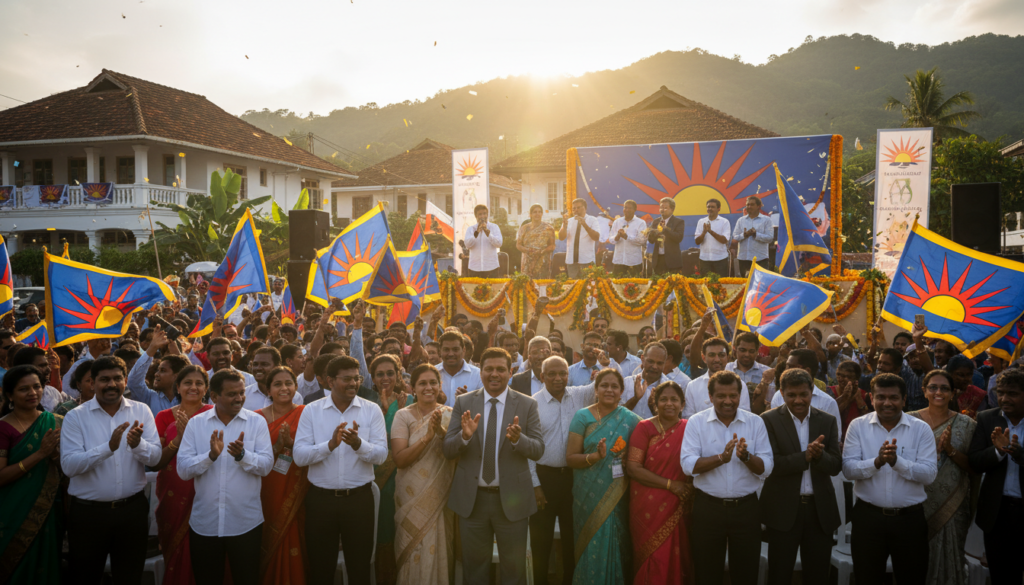
The Ilankai Tamil Arasu Kachchi (ITAK) achieved what its general secretary called a “phenomenal victory.” The party secured control of 43 out of the 58 councils it contested across the Northern and Eastern provinces.
It won a total of 377 seats at the grassroots level. This result re-established ITAK as the dominant political force for Tamil voters.
M.A. Sumanthiran, the party’s general secretary, thanked voters for their confidence. He stated the win was a clear endorsement of the party’s stance on core issues.
The triumph signals a return to traditional political channels for representation. It underscores a demand for focused advocacy on regional concerns.
NPP’s Failed Outreach and Eroded Trust
Conversely, the ruling party’s support eroded significantly in these areas. The National People’s Power failed to secure a majority in any local authority in the Tamil-majority regions.
This was despite an extensive and costly campaign effort in the North. The drop in support points to a deeper issue of eroded trust.
Many Tamil voters had placed hope in President Anura Kumara Dissanayake’s promises. A sense of disillusionment set in, with a feeling that his administration was “all talk and zero action” on critical matters.
Key factors contributed to this shift. The government’s perceived stance on the Prevention of Terrorism Act (PTA) caused concern.
Arrests of activists and a lack of substantial economic plans for the region further alienated the electorate. The local vote became a channel to express this frustration.
The result shows that national political narratives can quickly unravel when local expectations are unmet. For the ruling party, the message from the North and East is one of unmet promises.
Voter Turnout and Sentiment: A Message of Disillusionment
Official figures show a notable decline in the number of citizens who cast their ballots. The participation rate itself is a critical indicator of the public’s mood and engagement.
Analyzing this metric provides essential context for the raw seat counts. It helps explain the underlying shifts in political support.
Lower Participation Reflects Waning Patience
Voter turnout for the 2025 local government elections was just under 62 per cent. This marks a drop of approximately seven percentage points from the 2024 general election.
Such a decrease is significant in a short timeframe. It points to more than simple voter apathy.
Analysts interpret the lower participation as a sign of waning public patience. A segment of the electorate appears disillusioned with the pace of change.
People are judging the administration on its immediate performance. The initial excitement that brought National People’s Power to national office has cooled.
Local Issues Trump National Euphoria
Local polls are typically fought on community-level concerns. Garbage collection, road repairs, and water supply dominate these campaigns.
The results suggest the national political euphoria of 2024 has subsided. Public dissatisfaction with the government is costing it votes, observers note.
This dynamic is a normal phenomenon in mid-term or local contests. The focus shifts from grand national promises to tangible delivery.
For President Anura Kumara Dissanayake, the message is clear. Governing at the national level has not shielded his party from grassroots accountability.
The diminished vote share for the ruling party finds a clear reason here. When people vote in local elections, they prioritize their daily lived experience over broader political narratives.
Immediate Political Reactions and Post-Election Manuevers
The announcement of final tallies triggered a swift and strategic response from major political camps. Each group moved quickly to interpret the results in a way that served its future strategy.
Public statements from party leaders and officials outlined their initial positions. These declarations set the stage for complex negotiations at the local level.
NPP’s Stance: No Alliances with Opposition Blocs
The ruling party delivered a firm and unambiguous message. JVP general secretary Tilvin Silva stated the National People’s Power will not join opposition parties to form majorities in any council.
This categorical refusal shapes the post-election landscape. It means the group will not seek formal coalitions with its main rivals to administer local bodies.
The stance presents a practical challenge. In many hung councils, the party will need to find other ways to secure leadership positions.
SJB and SLPP Leaders Claim Their Own Victories
Leaders from the main opposition blocs framed the outcome as a success for their respective movements. Their reactions highlighted different paths forward.
Samagi Jana Balawegaya leader Sajith Premadasa has not yet publicly revealed his alliance plans. However, senior party MP Mujibur Rahman indicated a more aggressive approach.
Rahman said the SJB would actively try to take control of councils. This suggests internal dynamics between cautious leadership and members eager for local power.
For the Sri Lanka Podujana Peramuna, the mood was triumphant. Lanka Podujana Peramuna stalwart Namal Rajapaksa claimed the results were “just the beginning” of a rebuild.
He posted on social media that the performance affirmed a commitment to “principled politics from the ground up.” This resurgence signals the party‘s intent to remain a key player.
The United National Party, despite its diminished seats and votes, signaled a desire to pair up with the SJB. This points to potential opposition coalitions forming in specific localities.
These immediate reactions from the national party leaders set clear boundaries. All eyes now turn to the critical bargaining set to occur in the country’s most important urban council.
The Colombo Municipal Council: The Epicenter of Political Bargaining
The most intense post-election maneuvering is concentrated in the nation’s premier urban local authority. All major political groups recognize its symbolic and administrative weight.
Controlling this body is seen as a marker of political credibility. It manages the capital’s core services and budget.
The 2025 local poll results for this council are clear. The National People’s Power won 48 seats.
The Samagi Jana Balawegaya secured 29 seats. The United National Party obtained 13 seats.
With 117 total seats, a simple majority requires 59 seats. No single party achieved this, creating a classic hung council.
This deadlock turns the Colombo Municipal Council into the primary bargaining table. The arithmetic dictates that alliances are unavoidable for any group to lead.
A Hung Council and the Alliance Calculus
The numbers present a stark mathematical challenge. The ruling party holds the largest bloc but is 11 seats short of control.
An alliance between the two main opposition parties has been suggested. The Samagi Jana Balawegaya and the United National Party together would command 42 seats.
This combined bloc still falls 17 seats short of the 59 needed. It demonstrates that even traditional opposition cooperation is insufficient here.
This scenario directly tests the ruling party’s national stance. Its leadership has vowed not to form alliances with opposition blocs.
Adhering to that principle in Colombo could mean conceding control of the country’s most visible local government body. It poses a significant strategic dilemma.
The calculus forces every group to look beyond their immediate rivals. The path to a majority lies with the smaller players.
Kingmaker Potential for Smaller Parties
The remaining 27 seats in the council are held by an assortment of minor parties and independent groups. This fragmentation grants them outsized influence.
These smaller entities now hold the kingmaker potential. Their support could tip the balance for any of the larger blocs seeking to form an administration.
Community-based organizations and regional parties have become critical power brokers. Their demands will likely focus on hyper-local issues and development projects.
This dynamic shifts the bargaining power to the periphery of the national political landscape. It underscores how local elections prioritize immediate community concerns over broader ideological battles.
Several scenarios are possible, from a fragile multi-party coalition to a deadlock that delays the election of a mayor. The outcome will signal how political cooperation might function at other hung councils across Sri Lanka.
Control of Colombo is more than an administrative prize. It is a potent symbol of political influence in the heart of the nation.
Looking Ahead: Ramifications for National Politics
This electoral outcome functions as a crucial mid-term assessment for the ruling coalition. It signals eroded support and waning public patience just months into its national term. The administration’s policy alignment with international lenders has drawn sharp criticism, contributing to this sentiment.
The strong showing by traditional and ethnic-based political forces demonstrates their enduring resilience. This creates a new landscape where the ruling group must balance its reform agenda.
It now faces the practical need to manage community administrations, possibly through uneasy partnerships. Ultimately, this poll is not an endpoint.
It is a significant event that reshapes the political terrain. It places significant pressure on President Anura Kumara Dissanayake’s government to deliver on its promises in the years ahead.