
Acquiring a motor vehicle in Sri Lanka has become a significant financial challenge for ordinary citizens. The retail prices displayed in showrooms are often two to three times higher than the original cost of the automobile.
This steep increase is primarily due to the country’s complex structure of levies and duties on imported automobiles. While these charges are a crucial source of government revenue, they place a heavy tax burden on businesses and final buyers alike.
The process begins with the CIF value, which is the cost of the automobile, including insurance and freight. To this amount, the government applies several layers of duty. These include customs duty, excise duty, and other levies.
This article will break down each component of this fiscal policy. It explains how they combine to inflate the final sale price. The analysis will also cover recent changes, such as the SCCL adjustment, and its impact.
The cumulative effect influences market demand and has broader implications for the national economy. Understanding this system is key for any consumer considering a purchase.
Breaking Down Sri Lanka’s Complex Vehicle Tax Regime
A series of sequential government charges transforms the base cost of an automobile into its showroom figure. This system applies several levies one after another. Each new fee is calculated on a value that already includes the previous ones.
This creates a compounding effect. The final retail price ends up being significantly more than the original price paid overseas.
Customs Duty: The Foundation Based on CIF Value
The first major charge is customs duty. It is calculated as a percentage of the CIF value. CIF stands for Cost, Insurance, and Freight.
This is the automobile’s price when it arrives at the port. The duty rate is not a single figure. It varies based on the engine capacity and the type of automobile.
Smaller, more fuel-efficient models often attract a lower rate. Larger engines and specific categories face a higher percentage. This initial levy sets the foundation for all subsequent calculations.
Excise and Luxury Taxes: Tiered Rates for Different Vehicles
Once customs duty is added, excise duty is applied next. This is another significant layer in the nation’s fiscal structure. The rate is tiered.
It targets different segments of the market. Basic, small automobiles have one rate. Those deemed as luxury items, like large SUVs or high-performance cars, face a much steeper excise rate.
On top of this, a separate luxury tax can be imposed. This further increases the cost for higher-end models. The goal is to segment the market and generate revenue from premium purchases.
VAT, Surcharges, and the Total Tax Burden
Value Added Tax (VAT) is then levied. It is applied to the cumulative value. This value now includes the original CIF cost, customs duty, and excise duty.
Several other mandatory fees are also added to the bill. These surcharges contribute to the final amount the importer must pay.
- Port and Airport Development Levy
- Nation Building Tax (where applicable)
- Other specific customs surcharges
The process has a compounding effect. Each new charge is calculated on an amount that gets larger every step. This dramatically inflates the base cif value.
The sum of all these levies—customs, excise, VAT, and surcharges—forms the total tax burden. This burden is the primary reason for high retail costs. Understanding this layered system is crucial for anyone looking at showroom price tags.
How Vehicle Import Taxes Push Car Prices Higher in Sri Lanka
A numerical breakdown demonstrates the compounding effect of successive levies on imported automobiles. The final figure consumers see represents multiple layers of fiscal policy.
From CIF to Retail: A Step-by-Step Price Inflation
Consider an automobile with a CIF value of $10,000. This is its cost at the port, including insurance and freight. The first major charge is customs duty.
For a common sedan, this might be 30% of the CIF value. That adds $3,000 immediately. The taxable base now becomes $13,000.
Next comes excise duty. This tiered levy could be 50% for this category. It applies to the new value of $13,000. This adds another $6,500.
The cumulative value is now $19,500. A luxury tax may apply at this stage. If applicable, it could add 25% or more.
Value Added Tax (VAT) follows at 15%. This is charged on the total after previous duties. For our example, this could mean an additional $3,000.
Various surcharges are then included:
- Port and Airport Development Levy
- Specific customs surcharges
- Other mandatory fees
These might add another $1,000 to the bill. The total tax burden in this scenario exceeds the original CIF value. It effectively doubles the initial cost before other expenses.
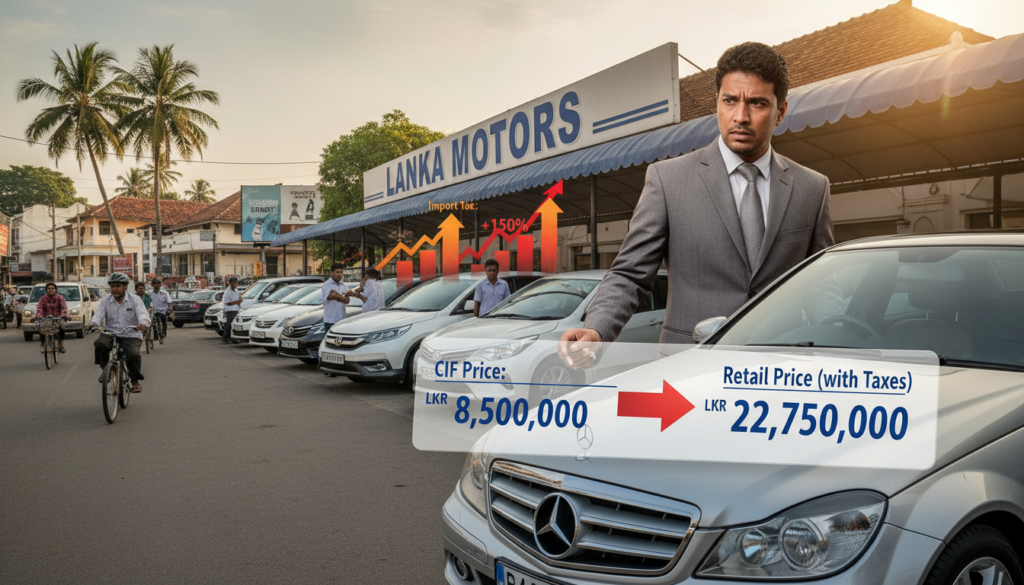
Importers must then add their operational costs. These are layered on top of the tax-inclusive figure.
Additional expenses include:
- Logistics and handling fees
- Dealer margin and profit
- Financing and interest costs
- Showroom and maintenance overhead
The original $10,000 automobile can easily reach a retail price of $25,000 or more. This illustrates the dramatic price escalation.
The Impact on Consumer Affordability and Demand
These high final figures create a critical barrier for most citizens. New automobile ownership becomes unattainable for a significant segment of the population.
Market demand is consequently suppressed. Sales volumes remain low compared to regional peers. The nation’s overall vehicle parc grows slowly.
Consumers adapt by extending ownership cycles. People keep their current automobiles for longer periods. This delays replacement purchases.
The used automobile market experiences increased activity. Buyers seek more affordable alternatives. This shifts business away from new dealerships.
Broader economic consequences follow. Automotive-related industries face reduced business. This includes parts suppliers, service centers, and financing institutions.
Government revenue from these sales may decline over the long term. Lower sales volumes mean fewer transactions to tax. This creates a complex fiscal dynamic.
Recent policy adjustments, like the SCCL, introduce another factor. They add to the existing structure of levies. This further complicates the pricing landscape for both businesses and buyers.
The SCCL Change: A New Levy at the Point of Entry
Industry analysis points to a specific new levy as a primary factor keeping retail figures elevated for the foreseeable future. This charge, known as the Single Customs Clearance Levy (SCCL), represents a recent adjustment to the nation’s fiscal framework for automobiles.
It is applied directly at the point of entry, adding another layer to the existing structure of duties and taxes. Understanding this change is crucial for grasping the complete cost picture.
What Is the Single Customs Clearance Levy (SCCL)?
The Single Customs Clearance Levy (SCCL) is a consolidated charge applied during customs clearance. Its stated purpose is to simplify certain administrative processes for authorities.
Mechanically, it is calculated as a percentage of the automobile’s CIF value. For example, a rate of 2.5% may be applied. This amount is payable by the importer upon the item’s arrival, before other duties are assessed.
This upfront financial requirement introduces a new, non-negotiable cost component. Analysts cite this levy as a key reason automobile prices may not see a reduction in 2026.
How SCCL Affects Importers’ Cash Flow and Final Costs
The SCCL’s timing creates an immediate financial impact. Requiring payment at the point of entry increases the importer’s immediate cash outlay.
This strains working capital, as significant funds are locked up earlier in the supply chain. For businesses, this cash flow pressure is a serious operational consideration.
To manage this, importers often factor the cost of financing this upfront payment into their final calculations. These additional costs are then passed on indirectly to the consumer through the final sale price.
Industry representatives have noted that while the SCCL may streamline some paperwork, it effectively increases the total tax burden on imported automobiles. It acts as another surcharge on top of customs duty and excise duty.
The result is a higher base cost before dealer margins and other expenses are added. This mechanism directly contributes to sustaining high retail prices in the market, aligning with the broader theme of layered fiscal policies.
The Road Ahead for Sri Lanka’s Automotive Market
Future mobility trends across the nation hinge critically on adjustments to the existing duty structure. The layered system of customs, excise, VAT, and the SCCL levy creates a persistent high-cost environment.
This fiscal framework is the primary driver of retail figures. It directly suppresses consumer affordability and overall market demand.
Sustainability questions arise. The current approach may encourage growth within the used automobile segment. Interest in electric models could increase if incentives align.
Government policy must balance revenue generation with the economic benefits of a vibrant sector. Without significant reform, access to new automobiles for the average citizen remains constrained.
Understanding this breakdown is crucial for consumers, businesses, and policymakers. It explains why final costs are so elevated across the national market.