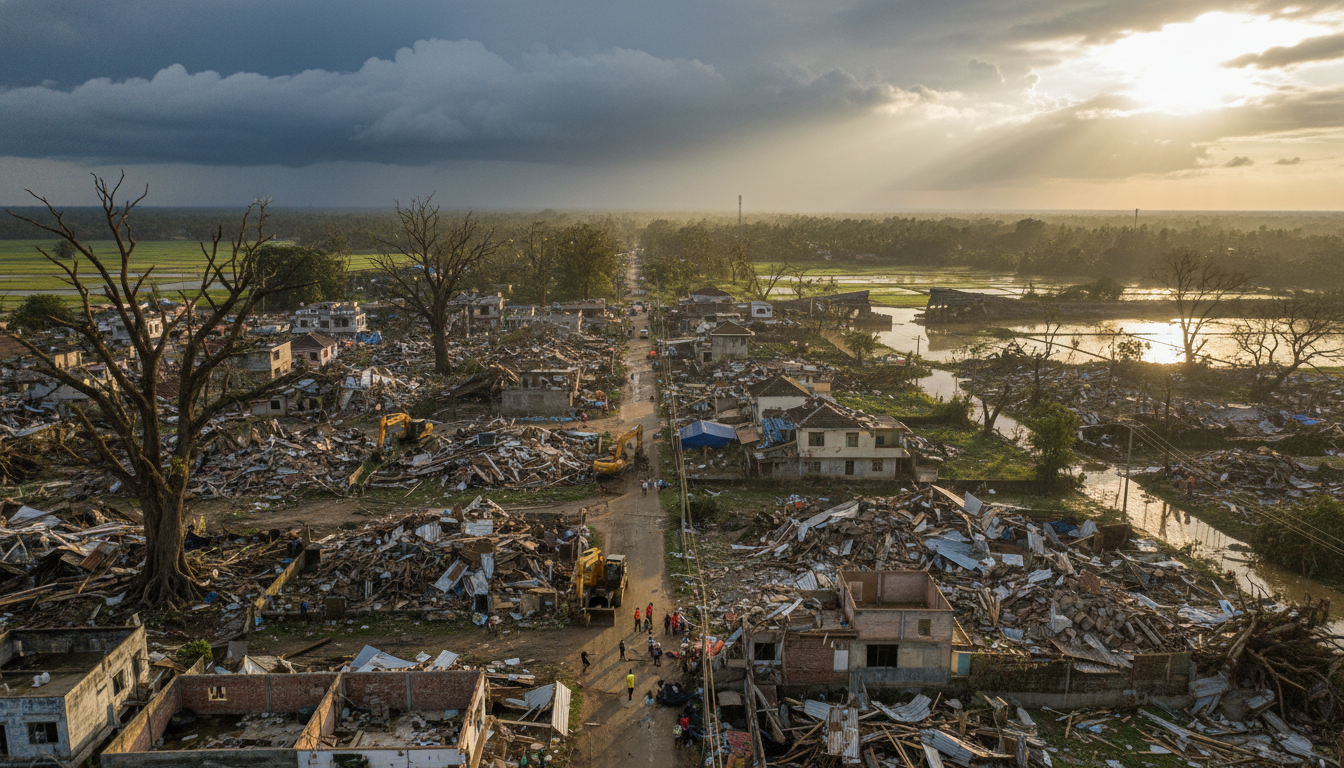
Sri Lanka faced one of its most severe national crises in recent memory when a powerful storm struck in late December 2025. The event, now known as Cyclone Ditwah, left a trail of destruction across the entire island nation.
The scale of the catastrophe is immense. A preliminary assessment from the World Bank puts the initial financial toll at approximately $4.1 billion. In response, the government has activated a massive Rs 1.2 trillion plan to guide the nation’s reconstruction.
Beyond the economic figures, the human cost is profound. Hundreds of lives were confirmed lost. Millions of citizens across all districts saw their homes and livelihoods disrupted by the devastating weather system.
Critical infrastructure suffered extensively. Roads, bridges, and power and water networks were severely compromised. This widespread harm to essential systems presents a central challenge for the coming restoration work.
The response involves substantial domestic financial mobilization. It is also supported by significant pledges of international aid. This dual effort aims to address the immediate needs and long-term rebuilding.
The nation now enters the early stages of a complex, multi-year process. The road ahead will test Sri Lanka’s collective resilience as it works to recover from this disaster.
The Staggering Economic Toll: A $4.1 Billion Blow to Sri Lanka
The economic impact of the late 2025 storm is now quantified, revealing a multi-billion dollar setback for the island nation’s development. A detailed assessment provides the hard numbers behind the visible destruction.
World Bank Report Quantifies Direct Physical Damage
The World Bank’s Global Rapid Post-Disaster Damage Estimation (GRADE) report delivered the definitive figure. It calculated direct physical damage at $4.1 billion.
This sum represents about 4% of Sri Lanka’s entire GDP. It is a foundational metric for grasping the event’s scale.
Broader economic losses, which include lost productivity and business interruptions, are estimated even higher. Other analyses place total economic losses between $6 and $7 billion.
This range surpasses the financial toll of the 2004 tsunami. It underscores the severity of this modern disaster.
Sector-by-Sector Breakdown: Infrastructure, Housing, and Agriculture
The World Bank report breaks down where the billions in damages occurred. The distribution reveals which parts of society were hit hardest.
- Infrastructure (42% – $1.7 billion): Roads, bridges, and railways suffered the bulk of destruction. This crippled transport and supply chains across the island.
- Housing (24% – $985 million): Over 6,000 homes were completely destroyed. Another 112,000 were partially damaged, creating a massive displacement crisis.
- Agriculture (20% – $814 million): This sector faced devastating losses. About 100,000 hectares of paddy were destroyed, with 150,000 more hectares damaged.
- Non-Residential Buildings (14% – $562 million): Schools, hospitals, and commercial buildings sustained heavy harm.
The ruin of vast paddy fields and other crops, plus severe livestock losses, threatens rural livelihoods. It also poses a significant risk to national food security.
Hardest-Hit Districts: Kandy, Puttalam, and Badulla Bear the Brunt
The geographic distribution of damage was not even. A few districts absorbed a disproportionate share of the national toll.
In absolute dollar terms, three areas suffered the most:
- Kandy District: $689 million in losses.
- Puttalam District: $486 million.
- Badulla District: $379 million.
Together, these three districts accounted for almost 40% of all national losses. Their economies and communities were fundamentally shaken.
Economists also used a metric called Total Exposed Value (TEV). It measures the proportion of a region’s existing wealth that was wiped out.
This analysis reveals a starker truth. Poorer regions like Vavuniya lost over 2% of their total asset base.
Wealthier commercial centers like Colombo lost a much smaller share. This shows how the storm exacerbated existing economic inequalities.
The World Bank cautions that the $4.1 billion direct damage figure is just the initial layer. Factoring in indirect impacts and full reconstruction, the final cost to Sri Lanka could reach $7 to $10 billion.
This means the true financial burden may be 1.75 to 2.5 times the direct physical toll. The road to economic recovery will be long and expensive.
Human Cost and Community Devastation
Behind the staggering economic figures lies a deeper tragedy measured in lost lives, shattered families, and uprooted communities. The storm’s impact on Sri Lanka is ultimately a story about its people.
Official data reveals the scale of personal loss and widespread disruption. The numbers provide a sobering view of the national disaster.
Lives Lost and Millions Displaced
The confirmed death toll reached 639 people, with another 203 reported missing. Most fatalities occurred in the districts of Kandy, Badulla, Nuwara Eliya, and Matale.
Sudden landslides and flash flooding in these areas made the events particularly lethal. The geography of the central hills amplified the danger.
Nationwide, over 2.3 million people were affected. This figure represents approximately 586,464 families.
More than 275,000 children were among them. Their lives were disrupted by lost homes, damaged schools, and trauma.
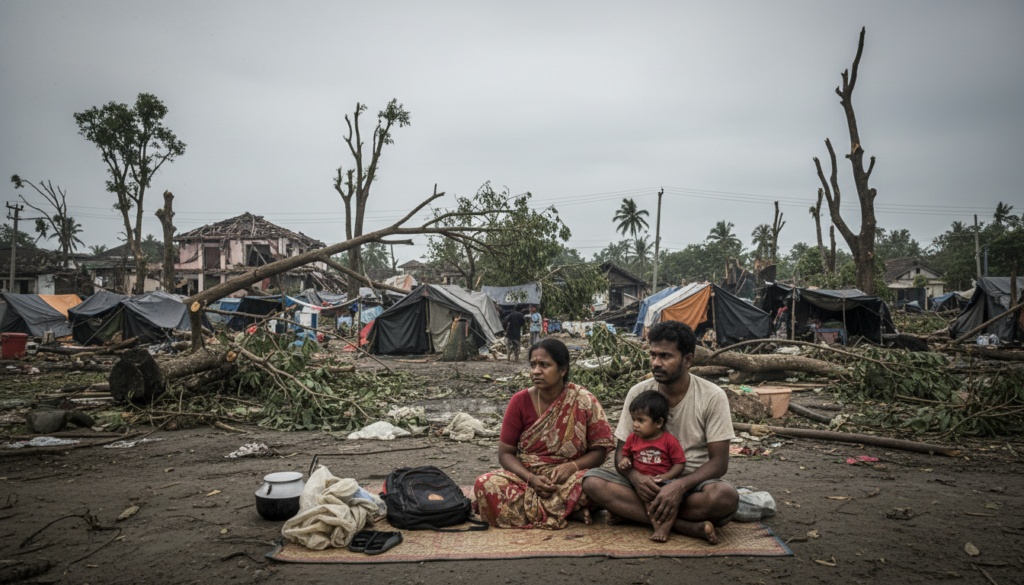
The destruction of housing created a massive shelter crisis. A total of 5,000 houses were completely destroyed.
Another 86,882 houses suffered partial damage. Tens of thousands of families found themselves suddenly displaced.
The Disaster Management Centre (DMC) established 878 safe centres. These shelters provided for 86,040 individuals from 27,145 displaced families.
Homes, Schools, and Sacred Sites Destroyed
The harm extended to the very pillars of community life. Places of learning, worship, and daily routine were severely compromised.
In the Central Province alone, 159 schools sustained damage. Of these, 115 were converted into temporary camps for the emergency response.
Religious sites across the island suffered extensive harm. This loss struck at the cultural and spiritual heart of diverse communities.
- 379 Buddhist Temples
- 165 Hindu Kovils
- 63 Churches
- 157 Mosques
In total, 764 sacred sites were damaged or destroyed. The UNDP provided further context on the cyclone’s reach.
They estimated floodwaters reached nearly 720,000 buildings across the country. This affected roughly one in every twelve structures.
Post-storm conditions also raised serious health concerns. Medical reports noted a 40% rise in heart attack risk linked to extreme stress.
Crowded shelters faced warnings of waterborne disease outbreaks. Conditions were ripe for the spread of illnesses like leptospirosis.
The data paints a picture of profound communal trauma. The massive infrastructure damages previously discussed translated directly into these urgent human needs.
Critical Infrastructure in Ruins
Beyond the immediate human tragedy, the event triggered a systemic failure of the nation’s critical support networks, from highways to power grids. The collapse of this physical backbone paralyzed daily life and commerce.
Repairing this infrastructure is not just about rebuilding assets. It is about restoring access to markets, services, and livelihoods for millions.
Transport Networks Severed: Roads, Bridges, and Railways
The storm devastated transport links, cutting off districts and breaking supply chains. Specific figures reveal the scale of the breakdown.
247 kilometers of main roads were damaged. The UNDP noted over 16,000 km of roads were exposed to flooding.
Over 40 bridges were affected. Complete collapses occurred in Mullaitivu and Yakkala.
The railways network was crippled. 70% of the system, or 1,115 km of track, was rendered unusable.
Road damage alone carries an estimated cost of 190 billion rupees. This massive bill highlights the scale of the disaster.
Collapse of Essential Services: Power, Water, and Communications
Essential services failed on a national scale. At the peak of the crisis, power outages hit 3.9 million consumers.
The Ceylon Electricity Board later restored most connections. The blackout highlighted the grid’s vulnerability.
More than 150 water supply systems were disrupted. Major treatment plants in Kandy and Ambatale were submerged or shut down.
This compromised clean water access for many communities. The failure of these essential services created a public health emergency.
Agricultural infrastructure was also heavily damaged. This directly threatened food production and water security.
The Department of Agricultural Services reported harm to:
- 1,777 tanks
- 483 dams
- 1,936 canals
- 328 agricultural roads
This damage to irrigation systems jeopardizes future crops. It compounds the sector’s massive economic losses.
The sheer geographic scale was staggering. UNDP data shows floodwaters inundated 1.1 million hectares of land.
This is almost 20% of Sri Lanka’s total area. Vast stretches were simply submerged.
Authorities made difficult decisions to manage the flood risk. Spill gates were opened in seven major reservoirs, including Kala Wewa and Rajanganaya.
This action prevented dangerous pressure buildup on dams. It was a necessary step in a dire situation.
The Kelani River reached historic levels, exceeding 8.45 feet at the Nagalagam Street gauge. This forced mass evacuations in Colombo suburbs.
The flooding of urban areas and key buildings showed the storm’s wide reach. The full cost of this disaster continues to affect the nation’s economic outlook.
Mobilizing the Response: Government and International Aid
The government’s response to the disaster was swift, anchored by a trillion-rupee domestic plan and bolstered by pledges from around the world. This massive mobilization involves both immediate relief and long-term recovery financing.
It represents a complex, multi-layered effort to address the crisis. The strategy combines national fiscal measures with coordinated international support.
The Rs 1.2 Trillion Domestic Recovery Plan
President Anura Kumara Dissanayake announced a Rs 1.2 trillion recovery programme. It is funded from the Treasury’s cash buffer and described as one of the largest reconstruction efforts in decades.
The plan is structured over three years, through 2028. The first phase in late 2025 focused on immediate emergency relief.
Major financial allocations are scheduled for 2026 and 2027. A final phase will focus on long-term resilience-building.
Direct relief payments to citizens formed a core part of the initial response. A Rs 25,000 cleanup allowance reached 88% of affected households.
A Rs 50,000 resettlement allowance was also provided. For fully destroyed homes, housing compensation grants of up to Rs 5 million were authorized.
Support extended to businesses and farmers to protect livelihoods. The government allocated Rs 106.2 million in industrial grants.
This provided Rs 200,000 each to 531 manufacturers. For agriculture, Rs 4.98 billion was disbursed to paddy farmers.
Another Rs 670 million went to farmers of other crops. This aid is crucial for restoring food production.
Domestic solidarity was shown through the Rebuilding Sri Lanka Fund. It surpassed Rs 697 million with contributions from Sri Lanka Cricket and Port City Colombo.
Global Solidarity: Pledges and Support from Abroad
The international community pledged significant financial support. Donor agencies committed approximately $500 million in total.
Multilateral institutions played a key role. The IMF approved $206 million under its Rapid Financing Instrument.
The World Bank activated $120 million from existing projects. The Asian Development Bank and other partners pledged about $500 million through 2026.
Over 70 countries pledged help with material and logistical aid. India deployed aircraft, bridge units, and rescue teams quickly.
The UAE established an air bridge for delivering supplies. China provided 85 tonnes of aid, and the United States committed $2 million.
This global effort complements the domestic plan. Together, they address immediate humanitarian needs and medium-term rebuilding.
The scale of this mobilization occurs against a challenging economic outlook. It tests the nation’s fiscal discipline while aiming to stabilize livelihoods.
The Long Road to Recovery and Resilience
Economic headwinds now complicate the massive task of reconstruction, with growth projections dimmed and final costs expected to soar. Analysts project the storm could shave 0.5 to 0.7 percent off Sri Lanka’s GDP, slowing the broader economic recovery. The World Bank warns total reconstruction costs may reach $7 to $10 billions, far exceeding initial damage estimates.
Experts voice concerns about implementation. Verité Research’s Raj Prabu Rajakulendran questions whether funds will reach people effectively and if recovery financed via loans is sustainable. Opposition analyst Harsha de Silva suggests raising the capital expenditure limit to meet urgent needs, a key fiscal debate as the government mobilizes resources.
The disaster’s impact on rural livelihoods is severe. Destroyed farmland and roads reduce incomes in vulnerable communities, requiring sustained support beyond physical repair. The final phase of the national plan focuses on strengthening community resilience in the hardest-hit districts.
This challenging economic outlook tests the nation’s resolve. The narrative across Sri Lanka highlights extraordinary citizen resilience through volunteer efforts and solidarity. The coordinated national and international effort is committed to the long reconstruction journey ahead.