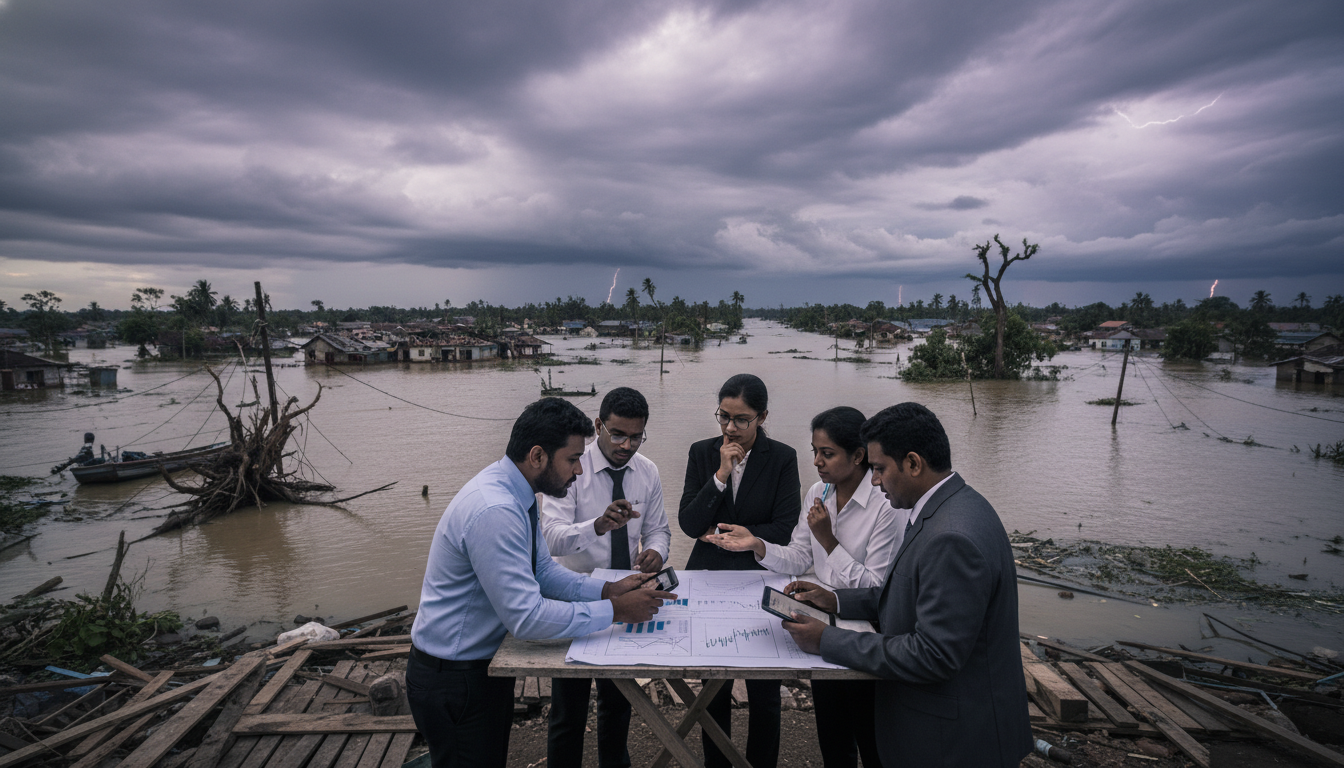
A powerful storm struck the island nation between late November and early December 2025. This event, known as Cyclone Ditwah, led to widespread loss of life and severe property destruction.
The World Bank calculated the total damage at US$4.1 billion. That figure equals four percent of the country’s gross domestic product from the previous year.
This analysis explores the storm’s profound effect on the national financial forecast for 2026. It marks a shift from a period of post-budget hope to a scenario filled with greater risk.
The tempest interrupted a fragile period of mending that was underway. Key sectors faced immediate disruption, derailing growth targets.
Such crises are not purely natural events. They are amplified by pre-existing social and economic weaknesses within a society.
The path forward requires a focus on transparent rebuilding efforts and smarter planning. Building long-term strength against future climate shocks is now a critical national priority.
How Cyclone Ditwah Shattered a Fragile Economic Recovery
The nation’s fragile progress from a deep financial crisis faced a devastating interruption from nature. After the historic 2022 debt default, a tentative stabilization was taking hold. Key indicators had begun to move in a positive direction.
Year-on-year GDP growth reached 4.9% and 5.4% in the second and third quarters of 2025. Core inflation fell to a manageable 2.4% by November of that year. Foreign currency reserves had also climbed to US$5.9 billion.
This turnaround was not accidental. It was underpinned by a US$2.9 billion IMF program active since 2023. Critical support also came from a US$4 billion emergency aid package from India in 2022.
However, underlying weaknesses made this economic recovery inherently fragile. An estimated 22% of the population lived in poverty. High rates of child malnutrition persisted. These social factors indicated the base of growth was not yet broad or secure.
The government pragmatically continued the IMF’s revenue-focused fiscal plans. This was despite earlier political promises to renegotiate terms. The 2026 budget, presented just before the storm, reflected this cautious optimism.
It targeted fiscal discipline while trying to accommodate essential welfare measures. This phase of careful rebuilding was the context when the disaster struck.
Cyclone Ditwah acted as a massive external shock. It directly damaged the physical assets and productive capacity essential for sustaining momentum. The storm’s force exposed a hard truth.
Economic progress in debt-distressed nations remains precarious. It is highly susceptible to climate-related disruptions. The crisis of 2022 had shown the country’s vulnerability, as detailed in this analysis of the economic outlook.
In a short time, the disaster wiped away months of hard-won gains. It shifted the national conversation from cautious growth back to urgent survival. The path ahead suddenly looked much steeper.
The Precarious Promise of Sri Lanka’s Pre-Storm Economy
Macroeconomic data from the final quarter of 2025 painted a picture of an economy on the mend. This progress, however, was built on a fragile foundation. The promise of stability was heavily dependent on avoiding any major new shocks.
Signs of Growth: GDP, Inflation, and Reserves on the Mend
Official figures showed encouraging trends. Year-on-year GDP growth reached 5.4% in the third quarter of 2025. Core inflation had been tamed, falling to 2.4%.
Foreign currency reserves climbed to a more comfortable US$5.9 billion. This improvement was not accidental.
Prudent monetary policy played a key role. Critical external support from a US$2.9 billion IMF program and earlier aid packages provided essential breathing room.
The Persistent Shadows: Poverty and the IMF’s Tightrope
Beneath the headline numbers, deep social challenges remained. An estimated 22% of the population lived in poverty. This reality highlighted that the benefits of growth were not yet widely shared.
The government walked a difficult policy tightrope. It had to adhere to strict fiscal discipline targets set by the International Monetary Fund. At the same time, it faced immense public pressure to address urgent welfare needs.
Balancing these demands was the central challenge for national development planning.
The 2026 Budget: Balancing Fiscal Discipline and Welfare Promises
This balancing act was clear in the national budget for 2026. Its theme was ‘Steady and Strong: Committing to Fiscal Discipline for a Resilient Economy‘.
The plan targeted a primary surplus of 2.5% of GDP. It aimed for total government revenue of 15.4% of GDP. This higher estimated tax-to-gdp ratio was meant to create fiscal space.
That space was allocated to political promises. Provisions included new homes for low-income families and investment in irrigation. It also covered salary increases for public servants and 75,000 new public sector jobs.
Most strikingly, the budget set a growth target of about 7%. This contrasted sharply with the IMF‘s more conservative projection of 3.1%.
Even before the storm, analysts questioned this ambitious growth target. Historical performance and global uncertainty made a 7% expansion a bold assumption. The 2026 budget thus reflected a precarious hope.
It tried to maintain crucial fiscal discipline while delivering tangible welfare to a population still grappling with poverty. The entire sector‘s recovery was contingent on a calm period that never arrived.
The Wrath of Ditwah: Measuring the Immediate Toll
Data from international agencies revealed a disaster of unprecedented national scope. The numbers provided a cold, factual measure of the immense suffering and loss.
A Nationwide Catastrophe: Lives Lost, Homes Destroyed
The human cost was severe and immediate. United Nations reports confirmed over 600 individuals were dead or missing.
More than 91,000 homes were either damaged or completely destroyed. This left countless people without shelter.
The storm’s reach was truly nationwide. All 25 districts in the country reported significant impacts.
This made it different from more localized weather events. Nearly 10% of the total population was affected.
That figure translates to approximately two million people. The scale of displacement and personal tragedy was immense.
Beyond the Tsunami: A $4.1 Billion Blow to the National Balance Sheet
The economic toll was quantified by a rapid assessment from the World Bank. Its Global Rapid Post-Disaster Damage Estimation (GRADE) report delivered a staggering figure.
Total direct damage was estimated at $4.1 billion. This sum represented a severe blow to the national balance sheet.
To understand the scale, this equaled four percent of the nation’s 2024 GDP. The disaster erased a significant portion of the year’s economic output.
Critical public infrastructure suffered extensive damage. Roads, bridges, and utilities were compromised across many areas.
Analysts noted a sobering comparison. While the 2004 Indian Ocean Tsunami had a higher immediate death toll, the widespread infrastructure damage from Cyclone Ditwah may result in a higher total economic cost.
The $4.1 billion estimate covers the value of destroyed assets. It does not account for longer-term losses in productivity and growth.
Rebuilding lost homes and public assets will require a massive national effort. The financial shadow of this event will linger for years.
This assessment by international experts laid bare the sheer magnitude of the shock. It moved the narrative from human tragedy to a macroeconomic crisis.
The Myth of the “Natural” Disaster: Inequality as a Force Multiplier
Calling such events ‘natural disasters’ often masks the human decisions that amplify their destruction. The term suggests an unavoidable act of nature. In reality, the scale of a catastrophe is shaped by pre-existing social and economic conditions.
Inequality functions as a force multiplier. It determines who is most exposed and who has the resources to recover. The storm’s impact was a product of layered institutional and policy failures.
When Hazard Meets Vulnerability: The Geography of Risk
Physical exposure to hazards is not random. It is shaped by socioeconomic disparity. Lower-income households often reside in high-risk zones because they cannot afford safer land.
Flood plains are densely settled by these communities. Informal settlements along waterways typically lack adequate drainage. Plantation community members frequently live on unstable slopes.

This creates a distinct geography of risk. Maps of the worst disaster damage closely overlap with maps of poverty. The climate event exploited these pre-existing vulnerability patterns.
The quality of housing and infrastructure in these areas is generally poor. This systematic vulnerability turns a weather event into a human catastrophe.
Land Use and Livelihoods: How Policy Design Amplified the Shock
Past policy choices permitted development in known hazard-prone areas. There was a consistent lack of investment in resilient infrastructure. This failure in land use planning increased community vulnerability.
Effective urban planning could have mitigated some damage. Drainage systems, slope stabilization, and better housing codes are essential. Their absence reflects a long-term policy gap.
The land itself becomes a trap for the poor. Without affordable, safe land options, communities have little choice. This change in approach is needed for future climate resilience.
Investment in urban planning and land use planning is not just about infrastructure. It is about protecting livelihoods and community well-being. The quality of this planning directly affects survival risks.
The Informal Economy’s Precarious Perch
A large portion of the workforce is part of the informal economy. Daily wage labourers, small farmers, and street vendors lack social protection. They have no insurance, savings buffers, or safety nets.
For these workers, the disaster meant immediate and total income loss. A single day’s disruption pushed households toward debt. This informal economy is highly sensitive to any shock.
Their livelihoods are inherently precarious. The storm highlighted the systemic lack of protection for informal workers. Recovery for these communities will be slower and more difficult.
This policy gap leaves a significant part of the population exposed. Building long-term strength requires formalizing protections. The risks to the housing and land security of the poor are immense.
The core message is clear. The catastrophe was not purely natural. It was amplified by human-made factors like inequality and poor urban planning.
The Economic Domino Effect: From Fields to Factories
The storm’s impact triggered a chain reaction across the national economy, from rural farms to urban factories. Physical destruction quickly translated into financial strain. This cascade of disruptions exposed how interconnected sectors are vulnerable to a single shock.
The immediate aftermath saw a paralysis of production and logistics. This threatened the broader stability that was painstakingly rebuilt. The path to recovery now involves navigating a series of linked challenges.
Agriculture and Exports: Critical Sectors in Crisis
The agriculture sector suffered devastating blows. Staple crops like rice and vegetables were wiped out across vast regions. This damage directly threatened food security and farmer livelihoods.
Key export industries faced severe operational disruption. Sri Lanka‘s famous tea estates reported widespread flooding and landslides. Factories in the garment and apparel manufacturing belt lost power and access.
Logistics networks were crippled, halting the movement of goods. Ports experienced delays, and shipping schedules collapsed. This crisis in production and supply chains had immediate financial consequences.
These exports are vital foreign exchange earners for the nation. A sustained drop in tea and garment shipments would worsen the trade balance. It could also increase pressure on the local currency’s value.
The damage to these primary sectors revealed a core economy weakness. Reliance on a few key industries makes the entire system fragile. Diversification is a long-term development goal that gained new urgency.
Infrastructure Paralysis and the Cost of Reconstruction
Critical infrastructure sustained extensive damage. Roads and bridges were washed away, isolating communities. Railway lines were blocked, and power transmission networks failed.
This led to a state of infrastructure paralysis. Damaged transport and energy systems hindered all other activity. Even relief and support efforts were complicated by blocked routes.
The concept describes how a breakdown in foundational systems causes wider economic shutdown. Factories cannot receive inputs or ship products. Workers cannot reach their jobs, and goods cannot reach markets.
Restoring full capacity requires a massive and costly reconstruction program. The financial burden of rebuilding roads, utilities, and public buildings is enormous. This cost must compete with other budget priorities in a tight fiscal space.
Reconstruction needs will also add to the import bill. Materials like steel, cement, and machinery may need to be sourced from abroad. This strains foreign reserves at a delicate time.
Strategic investment in resilient infrastructure is now a central debate. The development approach must account for future climate risks. The cost of rebuilding smarter is high, but the price of repeated failure is higher.
Why the 7% Growth Target Became a Fantasy
The government’s pre-storm growth target of 7% for 2026 became instantly unrealistic. This ambitious goal was set in the national budget just before the disaster. It contrasted sharply with the International Monetary Fund’s projection of 3.1%.
Widespread physical destruction made high-speed expansion impossible. The economy‘s productive base was significantly eroded. Factories, farms, and transport links needed time to repair.
The conservative IMF forecast now also appears at risk. The cascade of disruptions could suppress activity well into the year. Economists revised their projections downward across the board.
This revision highlights how a single shock can derail macroeconomic planning. The growth target was a symbol of optimistic pre-crisis planning. The post-disaster reality demanded a focus on stabilization over rapid expansion.
Achieving any positive growth will now depend on effective reconstruction. The speed and quality of rebuilding infrastructure and sectors like agriculture are key. The domino effect shows that recovery in one area supports progress in another.
The fantasy of 7% growth underscores a hard lesson for Sri Lanka. Economic planning must integrate climate vulnerability assessments. Targets must be resilient to the shocks that are increasingly part of the region’s reality.
Aid, Accountability, and the Flawed Response Mechanism
International donors and domestic authorities launched efforts to address the crisis. These initiatives faced immediate scrutiny over their design and effectiveness.
Questions of accountability and efficient resource channeling became central. The transition from rescue to recovery revealed significant flaws in the existing mechanisms.
The Rebuild Sri Lanka Fund: A Question of Governance and Gender
A domestically established vehicle, the Rebuild Sri Lanka Fund, was created to coordinate and finance recovery. Its formation aimed to centralize efforts and attract donations.
Criticism emerged swiftly regarding its governance structure. The management committee was composed exclusively of male senior officials and corporate leaders.
This all-male composition drew public concern. It raised questions about inclusive decision-making, particularly for gender-specific needs in the aftermath.
Transparency and effectiveness were also questioned. Observers wondered if such a fund could ensure resources reached the most affected communities.
Reports indicated limited financial flows into the Rebuild Sri Lanka Fund in its initial phase. This slow start undermined confidence in its operational capacity.
International Aid: A Drop in the Reconstruction Bucket?
The global community pledged financial support in the immediate aftermath. A rapid inventory of commitments shows the scale of the emergency aid.
The IMF Board approved a US$206 million Rapid Financing Instrument. India committed a substantial US$450 million package.
Other major contributions included US$120 million from the World Bank and US$43 million from the ADB. Bilateral pledges added smaller amounts.
The US pledged US$2 million, Japan US$2.5 million, and China US$143,000. When tallied, total emergency aid commitments reached approximately US$818 million.
A critical analysis reveals a stark shortfall. This pledged total covers only about 20% of the estimated US$4.1 billion in direct damage.
The financing gap for long-term reconstruction is therefore enormous. International aid, while vital, represents just a drop in the reconstruction bucket.
This gap highlights a sobering reality. The nation must find other resources to fund the vast reconstruction task ahead.
Systemic Gaps: Early Warnings and Distribution Failures
Beyond financing, deeper institutional weaknesses were exposed. Systemic failures in the disaster response cycle compounded the tragedy.
Reports cited a lack of effective early warnings for populations in the cyclone’s direct path. This failure in communication systems increased the human toll.
The slow distribution of aid and relief supplies became another major issue. Logistics bottlenecks delayed critical support to the worst-affected areas.
These distribution failures pointed to flaws in humanitarian logistics systems. Aid piled up in central locations while needs in remote districts went unmet.
Such gaps reflect long-standing weaknesses in disaster management systems. They show a disconnect between planning and practical, on-the-ground execution.
The quality of the emergency response is a direct test of institutional capacity. In this case, the systems in place were found wanting.
Critiquing these initial solutions is a necessary step. It sets the stage for proposing a more robust and accountable blueprint for recovery.
A Three-Pillar Blueprint for Building Back Better
Effective recovery demands a three-part blueprint that addresses both reconstruction and economic transformation. This integrated approach moves from immediate needs to long-term development.
The goal is to create a stronger, more resilient nation. Each pillar supports the others, forming a cohesive policy roadmap.
Pillar One: A Costed, Transparent Reconstruction Strategy with MDBs
The first step is a detailed, costed national reconstruction strategy. This plan must be developed in close partnership with multilateral development banks.
Institutions like the World Bank and the Asian Development Bank offer critical technical expertise. Their involvement ensures international oversight and access to concessional financing.
A transparent strategy builds donor and public confidence. It clearly outlines priorities, timelines, and funding sources.
The partnership should explore innovative models like public-private partnerships. PPPs can help deliver specific infrastructure projects more efficiently.
Key investments must focus on future climate resilience. Modern early warning systems are a non-negotiable first line of defense.
Critical infrastructure like roads, railways, and the energy grid must be rebuilt to higher standards. Housing programs should enforce disaster-resilient building codes.
This pillar is not just about rebuilding what was lost. It is about capacity building and upgrading the country’s physical systems.
Pillar Two: Prioritizing National Resources and Fiscal Flexibility
Over-reliance on unpredictable foreign aid is a risky strategy. The nation must proactively deploy its own national resources.
Significant domestic funds exist in under-spent capital budget accounts. These resources are held in state banks and can be rapidly reallocated.
Using a portion of foreign reserves for essential imports is another tool. This provides fiscal flexibility to secure basic food and medicine.
Such moves demonstrate sovereign management of the crisis. They can be faster than waiting for external support to materialize.
This approach complements, but does not replace, international partnership. It ensures the country leads its own recovery agenda.
Strategic use of domestic finances creates immediate momentum. It allows vital reconstruction work to begin without delay.
Pillar Three: A Comprehensive Growth Plan Beyond Stabilization
Stabilization, as guided by the IMF, is only the starting point. A forward-looking, comprehensive growth plan is needed for transformative development.
Studies, like the analysis by ODI and CEPA, provide a useful framework. The plan should focus on macroeconomic stability and global supply chain integration.
Improved factor markets and poverty reduction are essential foundations. The ultimate goal is to build a broad consensus for change.
The plan must capitalize on clear opportunities. Tourism, the digital economy, and niche manufacturing offer high potential.
Success requires improving the business environment and investing in skills. It is a long-term project that extends beyond this time of crisis.
This pillar links physical reconstruction directly to economic upgrading. It ensures rebuilding efforts contribute to a more diversified and competitive economy.
Together, these three pillars form a robust blueprint. They connect short-term recovery with a vision for a more resilient and prosperous future.
Sri Lanka’s New Reality: Navigating a Riskier Future
January 2026 marks a pivotal moment. Past vulnerabilities meet the urgent need for transformative policy.
The storm revealed deep-seated structural weaknesses in land use and labor. It shifted the national economic outlook from cautious hope to acknowledged risk.
In an era of climate change, intense weather events will likely recur. Inaction on resilience becomes a recurring cost for the country.
The path forward requires integrating risk reduction into all policy. This includes urban planning, social protection, and fiscal management.
Well-crafted, transparent policies can help navigate this riskier future. Success depends on building capacity and sustaining recovery efforts, as seen in the nation’s ongoing growth strategy.