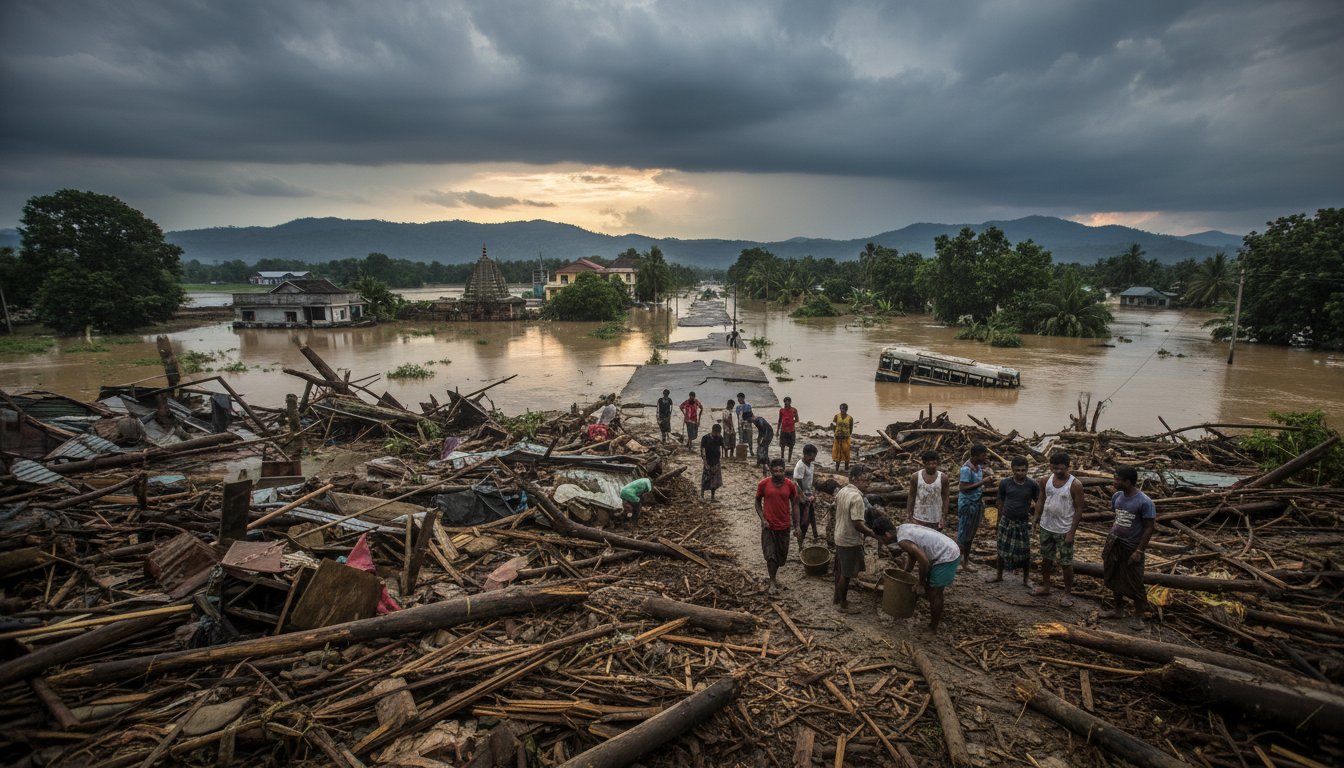
In late November, Cyclone Ditwah struck the island nation. The storm triggered catastrophic flooding and slope failures. This event has been called the largest and most challenging natural disaster in the country’s history.
The human cost was immense. Close to two million people were affected. The cyclone killed more than 640 individuals. It also forced over 66,000 from their homes.
A World Bank report from December estimated direct physical damage at US$4.1 billion. This staggering figure highlights the scale of destruction. It frames the immense task of rebuilding that lies ahead for Sri Lanka.
The crisis underscores the nation’s vulnerability to extreme weather. Many experts link such intense disasters to global climate change. Recovering will require more than just repairing infrastructure.
Sustainable development and future-proofing the country are now critical. This article examines the path forward for Sri Lanka after this historic disaster.
The Devastation of Cyclone Ditwah: A Nationwide Crisis
November 28 will be remembered as the day Cyclone Ditwah transitioned from a forecast to a devastating reality. The storm system made landfall and began dumping torrential rain across the country.
Its path was not confined to the coast. The cyclone’s intensity pushed deep into the island’s interior. This caused rivers to swell far beyond their banks.
Landfall and Immediate Impact
The immediate onslaught was relentless. Heavy rainfall measured in hundreds of millimeters fell within hours. This sudden deluge had two catastrophic effects.
First, it caused widespread flash and riverine flooding in low-lying areas. Second, it saturated the soil in the central highlands. This triggered deadly landslides in geographically vulnerable zones.
The central tea-growing region of Badulla was particularly hard-hit. Slopes gave way, burying roads and homes under mud and debris. This was a clear example of how a single natural disaster could manifest in multiple, simultaneous hazards.
From the earliest moments, the national Disaster Management Centre (DMC) activated its protocols. Its teams began monitoring the crisis as it unfolded. Their December 17 report provided a crucial, ongoing assessment of the damage.
This event was distinct from a localized incident. A nationwide crisis means multiple districts are affected at once. It strains response systems and resources beyond typical capacity.
Organizations like the Sri Lanka Red Cross Society mobilized immediately. Their volunteers were among the first on the ground. They worked to provide urgent aid to the affected million people.
The sequence of events—landfall, rain, flood, landslide—showcased the raw force of nature. Normal life came to a standstill for countless Sri Lankan families. This breakdown of daily routine highlighted the scale of the challenge.
Such extreme weather events are becoming more frequent in the region. Effective disaster management must now account for this new reality. The response to Cyclone Ditwah sets a factual foundation for understanding the specific impacts that followed.
Immediate Human Toll: Casualties and Displacement
Official tallies of the disaster‘s impact reveal a staggering loss of life and widespread displacement. The numbers provide a sobering measure of the tragedy.
Nationwide, the cyclone killed more than 640 people. It also forced over 66,000 individuals from their homes. These figures represent the core human casualties.
Fatalities and Injuries Across Districts
The pain was not evenly spread. Certain areas suffered disproportionately. The Badulla district recorded 88 fatalities alone.
Close to 92,000 people were affected in that region. Many survivors sustained significant injuries. Treating them strained local medical systems.
Coordinating care across affected districts was a major challenge. Damaged roads and communications hindered efforts. This complicated the emergency medical response.
Those displaced sought refuge wherever possible. Schools, temples, and community halls became makeshift shelters. These facilities were quickly overwhelmed.
Living conditions in temporary sites were difficult. There was an urgent need for clean water, food, and sanitation. Providing basic security was also a priority.
The Sri Lanka Red Cross Society mobilized rapidly. Red Cross volunteers were on the ground from the earliest hours. They delivered critical aid to the displaced populations.
This lanka red cross effort focused on immediate survival needs. Their work highlighted the scale of the humanitarian crisis. The entire country felt the impact.
Addressing these casualties and injuries was just the first step. The larger issue of finding permanent housing for thousands loomed. Sri Lanka faced a long road ahead.
The event marked one of the most severe natural disasters in recent memory for Sri Lanka. The data from the Disaster Management Centre confirmed the scale. Rebuilding lives would require sustained effort.
Badulla District: Epicenter of Landslide Destruction
Badulla district, a picturesque region in the island’s interior, suffered the most concentrated damage from the cyclone’s triggered landslides. This central highland area, famed for producing Ceylon tea, became the epicenter of slope failure devastation.
Tea Plantations Buried Under Debris
The terraced hillsides, once meticulously groomed for cultivation, were brutally scarred. A month after the event, the landscape was littered with mounds of upturned soil and broken concrete.
There is a stark geographical irony at play. The steep slopes that are ideal for tea plantations also make the land exceptionally vulnerable during extreme rainfall. Officials note that about 70% of the terrain in this region is prone to landslides.
The human impact within the Badulla district was severe. Close to 92,000 people were affected by the cascading earth and mud. This number represents a significant portion of the local population.
Critical economic assets were destroyed. Vast stretches of tea plantations were buried under thick layers of debris. This damage to a key industry directly threatens regional livelihoods.
Local authorities faced immense hurdles. The Badulla Disaster Management Centre worked to assess the widespread damage and coordinate the initial response. Their task was complicated by blocked roads and disrupted communications.
This scale of physical ruin in the Badulla district forms the foundation for understanding the broader financial toll. The destruction of infrastructure and productive land translates into massive economic loss.
Economic Fallout: Assessing the Financial Damage
A detailed assessment by the World Bank has put a precise dollar figure on the cyclone’s destructive power. This analysis moves the conversation from immediate rescue to long-term reconstruction.
The numbers reveal the sheer scale of the task ahead. Rebuilding will require massive investment and careful planning.
World Bank Report on Direct Physical Losses
A December report from the World Bank Group provided a stark accounting. It estimated direct physical losses from the event at US$4.1 billion.
This figure represents the cost to repair or replace what was destroyed. It covers damage to buildings, household contents, agriculture, and critical infrastructure.
Roads, bridges, and utilities suffered crippling blows. This damage disrupts commerce and daily life across the country.
The economic damage to agriculture is particularly severe. Lost crops and ruined land threaten food security and farmer incomes.
To understand this figure’s magnitude, historical context is key. Recorded disaster damages in Sri Lanka totaled nearly US$7 billion from 1990 to 2018.
The recent cyclone’s toll in a single event is therefore historic. It dwarfs losses from recent events like 2016’s Cyclone Roanu.
That storm caused over US$600 million in damages. The current disaster is nearly seven times larger in financial terms.
Such a massive shock strains any national economy. For Sri Lanka, it comes during its worst financial crisis in decades.
The economic damage directly challenges future development goals. Funds needed for reconstruction are immense.
This direct physical losses metric is crucial for planners. It sets a baseline for the required reconstruction funding.
Addressing this scale of loss will test the country‘s institutions and resources. Sustainable development now depends on rebuilding smarter.
Future-proofing against climate change is no longer optional. It is an economic necessity for Sri Lanka.
Social Impacts: Vulnerable Communities Bear the Brunt
While statistics capture the scale of destruction, they often mask the uneven distribution of suffering across different social groups. The social impacts of a major natural event are never felt equally.
Vulnerable communities consistently endure the most severe consequences. This pattern highlights deep-seated issues within the nation’s social fabric.
Poverty and Inequality Exacerbated
Sri Lanka’s economic profile presents a complex picture. The national poverty headcount was a relatively low 3.1% in 2016.
Yet, wealth inequality is pronounced. The richest quintile holds 53.3% of total household income, according to data.
This disparity means a large portion of the population lacks financial buffers to absorb a major shock. When disasters strike, the poor are far more exposed.
Lower-quality housing, fewer resources for evacuation, and dependence on climate-sensitive livelihoods like farming increase their risk. These people have less capacity to recover.
The disruption to essential services creates long-term setbacks. Damaged schools directly hinder children’s access education.
Destroyed health centers cripple a community’s healthcare for months. This erosion of human capital undermines national development.
Past events illustrate this recurring pattern. The 2016 floods heavily affected metropolitan districts with high concentrations of poverty.
Loss of daily wages and destabilized food security hit low-income families hardest. Such shocks can push households back into poverty, reversing years of progress.
Effective recovery for Sri Lanka must address these deep-seated social vulnerabilities. Building a more resilient country requires protecting its most at-risk citizens first.
This challenge is compounded by broader economic challenges, where support for human capital and social protection is critical.
Floods and Landslides Leave Long-Term Recovery Challenges for Sri Lanka
Rescue operations have concluded, marking a shift toward a protracted and difficult recovery period. The immediate danger has passed, but a new set of complex recovery challenges now defines the national effort.
Officials from the Sri Lanka Red Cross Society confirm this transition. The country has moved past the emergency response phase. It is now firmly in the rebuilding stage.
From Emergency Response to Sustained Recovery
This new phase involves three interconnected tasks. Communities must resume livelihoods, find permanent accommodation, and address widespread psychological trauma. Each task is monumental on its own.
The process is further complicated by the nation’s ongoing economic crisis. Limited governmental resources are stretched thin. This reality makes long-term recovery an uphill battle.
The psychological impact on survivors is a significant hurdle. Grief, anxiety, and the stress of prolonged displacement take a heavy toll. Healing this trauma is essential for true community restoration.
Cultural factors also present cultural barriers to pragmatic solutions. Many people have deep ties to their ancestral land. This attachment can make relocation plans, however safe, emotionally difficult to accept.
Real-world examples illustrate the slow pace. Families like that of Karupiah Velayutham live in temporary shelters for weeks. They await official soil stability tests before knowing if they can return home.
This uncertainty hampers personal and community planning. The path to development after such a disaster is neither quick nor linear. It requires patience and sustained support.
The broader context of global climate change adds urgency. Rebuilding must not simply replace what was lost. It must create more resilient communities to face future threats.
For Sri Lanka, the journey of long-term recovery is just beginning. The coming sections will explore specific dilemmas, from relocation to livelihood restoration, that define this critical period.
The Relocation Dilemma: Balancing Safety and Heritage
Following the immediate rescue phase, a complex social dilemma has emerged for thousands of families. Authorities must decide whether to permit rebuilding in high-risk areas or enforce community relocation to safer ground.
This choice pits technical safety mandates against deep-rooted cultural and economic ties. It is one of the most profound recovery challenges now facing the nation.
Landslide-Prone Zones and Resident Reluctance
Technical assessments provide a clear, sobering rationale for moving people. In the Badulla region, about 70% of the land is classified as prone landslides.
Government geologists are actively surveying damaged areas. Their reports will determine which houses are safe for habitation.
For many Sri Lankan families, however, the data conflicts with powerful personal bonds. There is significant reluctance to move from ancestral homes.
This attachment is not merely sentimental. It is woven into community cohesion and cultural identity. Uprooting people risks severing these vital social threads.
The economic dimension intensifies the reluctance. For tea estate workers, their livelihoods are intrinsically tied to the land.
These workers typically live in housing provided on or near the plantations. Relocation to a distant, safer site could mean losing their job and primary income source.
The final decision on relocation rests with the government. Disaster management officials acknowledge the immense difficulty.
They must balance reducing future risk with preserving community viability. A Sri Lankan Red Cross representative noted the psychological toll of this uncertainty on affected families.
This situation contrasts with other climate adaptation strategies, like planned relocation in Tuvalu. There, the threat is a slowly rising sea.
In landslide-prone zones, the danger is immediate and the social fabric is tightly linked to the hazardous geography. Effective disaster management here requires more than engineering solutions.
It demands a sensitive approach that considers livelihoods, heritage, and safety. The path forward for tea estate workers and other residents remains a carefully weighed decision.
Livelihoods at Risk: Agriculture and Tea Production
The agricultural sector, a vital pillar of the economy, faces unprecedented threats. These come from both sudden disasters and gradual climate shifts.
Cyclone Ditwah delivered a brutal, immediate blow. Landslides and flooding destroyed entire tea production estates. They also ruined pepper gardens and other vital croplands.
Damaged roads and bridges then cut off access to surviving fields. This hindered harvests and the transport of goods to market. The direct physical damage was severe and widespread.
Crop Yields Eroded by Erratic Weather
A more insidious problem has been weakening the sector for years. Local farmers report steadily declining crop yields. This is linked directly to changing weather patterns.
Pepper, a sun-loving crop, serves as a clear example. Its productivity has fallen over the past six years. Unpredictable rains and temperature shifts disrupt its growth cycle.
These impacts climate change are chronic. They erode farmer resilience long before a major storm hits. The result is a sector already under stress.
Agriculture is not just an economic activity. It is the foundation of national food security and a key source of export income. Products like Ceylon tea are globally recognized.
When harvests fail, both domestic supplies and foreign earnings suffer. This dual threat makes the sector strategically important. Protecting it is essential for national stability.
Millions of people depend on farming for their survival. Data from 2016 shows approximately 1.8 million families were engaged in paddy cultivation. This highlights the immense social footprint of agriculture.
Erratic weather patterns create a vicious cycle. Lower crop yields mean reduced incomes and increased poverty. This makes farming communities more vulnerable to future disasters.
Recovery efforts must address this cycle. Simply replanting lost crops is insufficient. Long-term strategies must build resilience against climate change.
Rebuilding smarter agriculture is a core part of sustainable development. It requires investing in climate-adaptive practices and protecting the land. The future of rural people depends on it.
Climate Change Fingerprints on Extreme Weather Events
Researchers have identified the clear fingerprints of a changing climate on extreme weather events in the region. A growing scientific consensus links the increased severity of storms to human-induced global warming.
This connection is no longer theoretical. Advanced analysis now allows scientists to quantify the influence of climate change on specific disaster events. This field is known as attribution science.
Groups like World Weather Attribution specialize in this research. They analyze how factors like greenhouse gas emissions alter the probability and intensity of weather events.
Scientific Analysis from World Weather Attribution
A December 11 analysis by this group provided critical insights. It examined recent deadly storms in Asia, including Cyclone Ditwah.
The study found these storms were “supercharged” by higher sea surface temperatures. Warmer oceans provide more energy and moisture, fueling more intense rainfall.
Rapid deforestation was cited as a worsening factor. Loss of tree cover reduces the land’s ability to absorb heavy rains. This increases runoff and the risk of flash flooding.
For Sri Lanka, these findings translate to tangible risks. Warmer ocean temperatures in the surrounding seas create a more volatile environment. They can lead to more powerful cyclones forming nearby.
Furthermore, the region’s monsoons are becoming less predictable. Traditional weather patterns are shifting, leading to periods of intense drought followed by deluges.
These volatile monsoons are a direct impacts climate change. They contribute to higher flood risks across the island nation.
Local experts corroborate this scientific analysis. A Red Cross official in Sri Lanka noted observable changes on the ground.
They report that rainfall intensity during storms has noticeably increased in recent years. Community preparedness plans must now account for these new extreme weather realities.
Recognizing the climate change fingerprint is not about assigning blame. It is a critical tool for understanding future risk.
This knowledge is essential for designing effective, future-proof adaptation strategies. Disaster risk reduction must evolve based on this evidence.
The discussion moves from analyzing a single event to managing long-term trends. Building resilience requires acknowledging the altered baseline of our weather patterns.
For Sri Lanka, this means that rebuilding efforts cannot simply restore the past. Infrastructure and community plans must be designed for the climate of tomorrow, not yesterday.
Comparing Disasters: From the 2004 Tsunami to Cyclone Ditwah
The 2004 Indian Ocean tsunami and Cyclone Ditwah represent bookends of devastation in recent Sri Lankan history. Both events rank among the largest sri lanka disaster occurrences. They offer a stark comparison in how the country faces natural threats.
Analyzing these two catastrophes reveals critical shifts. It shows changes in geographic impact and financial toll. The comparison also highlights evolution in national response capabilities.
Geographic Spread and Infrastructure Damage
The tsunami 2004 was a coastal catastrophe. Its destructive force was largely confined to the island’s shoreline belt. The indian ocean surge inundated towns and villages along the coast.
In contrast, Cyclone Ditwah’s impact was nationwide. It affected almost all districts across the island. The storm caused destruction from the coast deep into the central highlands.
This difference in spread led to distinct patterns of infrastructure damage. The tsunami’s damage was intense but geographically concentrated. It wiped out coastal roads, bridges, and fishing harbors.
The cyclone’s infrastructure damage was more diffuse. It severed critical inland road networks in plantation areas. Landslides blocked mountain passes and buried rural highways.
Such widespread harm complicated emergency response and logistics. Repair crews faced challenges across multiple provinces simultaneously. This tested the nation’s disaster management systems in new ways.
The financial estimates underscore the scale difference. The ocean tsunami caused an estimated US$1 billion in damages. Cyclone Ditwah’s toll is estimated at US$4.1 billion.
Both figures are monumental for the country‘s economy. The fourfold increase highlights growing disaster costs. It reflects the expanding footprint of major lanka disaster events.
Reflecting on lessons learned from the tsunami 2004 is crucial. The post-tsunami reconstruction era saw massive international aid. It also involved rebuilding coastal communities with new zoning laws.
Some lessons learned were about community relocation and early warning systems. The question now is whether those insights were applied. Did they help manage the recent cyclone crisis more effectively?
Disaster preparedness has undoubtedly evolved over two decades. The national disaster management center has more tools and protocols. Public awareness of natural hazards is higher.
Yet, the cyclone revealed persistent gaps. Inland communities were less prepared for landslides than coastal towns were for tsunamis. This shows risk reduction efforts must be holistic.
Each major event offers critical insights for improving resilience. The indian ocean tsunami 2004 taught the country about coastal vulnerability. Cyclone Ditwah highlights inland and agricultural vulnerabilities.
The analytical takeaway is clear. People and planners must prepare for diverse threats. Building back better requires learning from every sri lanka disaster.
Sri Lanka’s Vulnerability to Natural Hazards: A Historical Context
Understanding the nation’s long-term exposure requires examining its historical vulnerability to natural hazards. The island’s disaster profile is shaped by its location and terrain.
This inherent susceptibility has impacted sri lanka for generations. It forms a continuous backdrop to the nation’s development story.
Floods, Landslides, and Cyclones in the Disaster Profile
The country faces a diverse array of threats. These include monsoonal rain, flooding, slope failures, and tropical storms.
Droughts and coastal erosion also pose significant risks. Seasonal and localized floods form the single greatest threat to communities.
Each hazard follows distinct patterns. The southwest monsoon brings heavy rains from May to September. The northeast monsoon affects different regions from December to February.
Tropical cyclones typically develop in the Bay of Bengal. They can strike the island from October to December. This seasonal rhythm defines the annual risk calendar.
Geographical distribution is equally important. The central highlands are most susceptible to landslides. Low-lying coastal and river basin areas bear the brunt of floods.
Quantifying this risk reveals a stark picture. About 20% of the nation’s land area is classified as vulnerable to slope failures. This equals roughly 13,000 square kilometers.
The economic history of these events is documented. Recorded damages from natural hazards totaled nearly US$7 billion between 1990 and 2018.
This figure represents a massive drain on national resources. It underscores the recurring financial impact of such disasters.
A clear trend shows increasing hazard frequency. The occurrence of hydro-meteorological events surged 22 times in the last decade alone.
This acceleration is a critical part of the modern disaster profile. It points to a changing environmental baseline.
Climate change acts as a powerful risk multiplier. Scientific consensus confirms it intensifies rainfall during storms. It also contributes to rising sea levels and warmer ocean temperatures.
These factors can increase the potential intensity of cyclones. The 2019 UNDRR Status Report provides authoritative data on these trends.
The report highlights growing exposure for sri lanka. It confirms that weather-related disasters are becoming more common and severe.
The current challenges are not isolated incidents. They are part of a long-term pattern exacerbated by global environmental change.
This historical context frames the nation’s disaster risk landscape as a systemic issue. Effective management requires acknowledging this persistent vulnerability.
Sustained, strategic action is needed to build resilience. The history of natural hazards in sri lanka informs the path forward.
Disaster Risk Reduction Efforts: Progress and Gaps
The nation’s approach to minimizing disaster impacts is guided by both domestic law and international agreements. Significant strides have been made since the 2004 tsunami. Yet, persistent vulnerabilities highlight areas needing urgent attention.
This framework aims to protect lives and economic assets. It combines policy, technology, and local action. The goal is a more resilient society.
Sendai Framework Implementation in Sri Lanka
Sri Lanka established a legal foundation with its Disaster Management Act of 2005. This created the national management centre and formalized response structures. Later, the country aligned with the global Sendai Framework for Disaster Risk Reduction.
This international pact sets clear priorities. They include understanding risk and strengthening governance. It shifts focus from mere response to proactive risk reduction.
Key initiatives under this framework are visible. The development of early warning systems for floods and slope failures is a major achievement. These systems provide critical lead time for evacuation.
Parallel programs train volunteers in community preparedness. Local people learn first response and risk mapping. This grassroots engagement is vital for effective disaster management.
However, a 2019 UNDRR Status Report outlined clear gaps. Warnings do not always reach the most remote or vulnerable populations. Messages may not be in locally understood formats.
Building climate-resilient infrastructure remains another challenge. Many roads and bridges are not designed for today’s intense climate change-driven weather. This is a systemic weakness in national disaster risk management.
The report serves as a benchmark for progress. It shows where Sri Lanka has advanced and where it lags. Filling these gaps is essential for true resilience.
Current recovery from the cyclone must address these systemic issues. “Building back better” means integrating stronger disaster risk reduction principles. Reconstruction should use updated, hazard-resistant standards.
Effective disaster risk management is a smart investment. It safeguards development gains and saves future costs. For Sri Lanka, closing these gaps is a pathway to sustainable security.
International Support and Aid Initiatives
International aid organizations began mobilizing resources within days of the disaster. This international support became a vital supplement to national response efforts.
It provided extra manpower, specialized skills, and financial resources. These elements helped address the immense scale of needs across the country.
Singapore Red Cross and Needs Assessment Missions
A key example of this collaboration was the swift action of the Singapore Red Cross. In December, it deployed a team of four trained responders.
These professionals participated directly in aid distribution. They also conducted crucial on-ground needs assessment missions.
A needs assessment is a critical process in effective disaster relief. It involves systematically identifying what affected people require most urgently.
- Teams interview families in shelters and damaged villages.
- They evaluate gaps in food, water, shelter, and medical care.
- This data guides where to channel aid and resources efficiently.
The financial aspect of international support is also significant. By December 27, the Singapore Red Cross had raised at least $200,000 through its public fundraising appeals.
Such funds are channeled to specific relief and recovery projects. They purchase essential items like hygiene kits and temporary shelter materials.
This external aid operates in close coordination with national authorities. It works alongside local organizations like the Sri Lanka Red Cross Society.
The lanka red cross provides vital local knowledge and networks. This partnership ensures aid reaches the communities that need it most.
The narrative maintains a factual tone. The scale of international support, while valuable, is understood relative to the enormous need.
Such solidarity represents a key component of the global response to major disaster events. This is especially true for crises linked to climate change impacts.
The practical value of this disaster relief is clear in the short term. It provides immediate comfort and stability to affected people.
Long-term recovery, however, must be nationally led and sustained. International support provides a crucial bridge during the most acute phase.
Building Back Better: Principles for Reconstruction
The philosophy of ‘Building Back Better’ has become a cornerstone of modern post-disaster recovery strategies worldwide. It moves beyond simple replacement of damaged assets.
This approach aims to reconstruct in a way that reduces future risk. It seeks to create communities that are stronger and more resilient than before.
For Sri Lanka, applying this principle is not optional. It is a necessary response to the increasing frequency of severe weather.

Climate-Resilient Infrastructure Standards
Officials and experts emphasize the urgent need for updated climate-resilient infrastructure standards. These new codes must account for intensified rainfall and heightened landslide risk.
Examples include improved drainage systems to handle sudden deluges. Reinforced slopes and retaining walls can stabilize vulnerable hillsides.
Buildings should be designed to withstand stronger winds and water pressure. Using locally appropriate, durable materials is key.
A Sri Lankan Red Cross official recently stated, “We cannot rebuild using yesterday’s standards for tomorrow’s climate.” This sentiment captures the core challenge.
Enforcing these updated construction codes in hazard-prone areas is critical. Effective land-use planning regulations must guide where rebuilding is permitted.
Parallel to physical construction, strengthening early warning systems is essential. These warning systems must be accessible to all communities, including remote villages.
Alerts need to be timely, understandable, and actionable. They should provide clear instructions on evacuation routes and safe shelters.
Integrating disaster risk management into all sectoral development plans creates systemic resilience. This means agriculture, health, and education policies all consider risk reduction.
For example, rebuilding a school involves not just constructing a building. It includes choosing a safe site and designing it as a potential community shelter.
This forward-looking approach directly addresses local challenges. Replanting tea estates may involve terracing techniques that reduce soil erosion.
Relocating villages requires careful planning to ensure new sites offer both safety and livelihood opportunities. The goal is to avoid recreating vulnerability.
The path of building back better is demanding but achievable. It represents a pragmatic investment in a more secure future for Sri Lanka.
It turns recovery from a single disaster into an opportunity for sustainable development. This is how nations adapt to the realities of climate change.
Community Resilience: Personal Stories of Loss and Hope
Two personal stories, from a tea plantation worker and an elderly craftsman, illustrate the human dimension of the catastrophe.
Karupiah Velayutham, 65, represents the uncertainty many people face. He has lived in a temple for weeks. He waits to learn if his cracked home on unstable land is safe.
R.A.R. Premadasa, 78, embodies determined hope. He lost his house of 50 years. Yet, he resumed his car repair work from a makeshift shelter. “I want to rebuild my life,” he stated.
Brave search rescue teams saved countless lives when the disaster struck. Now, the long road of rebuilding tests community resilience. These individual struggles form the foundation for the country‘s development path forward.