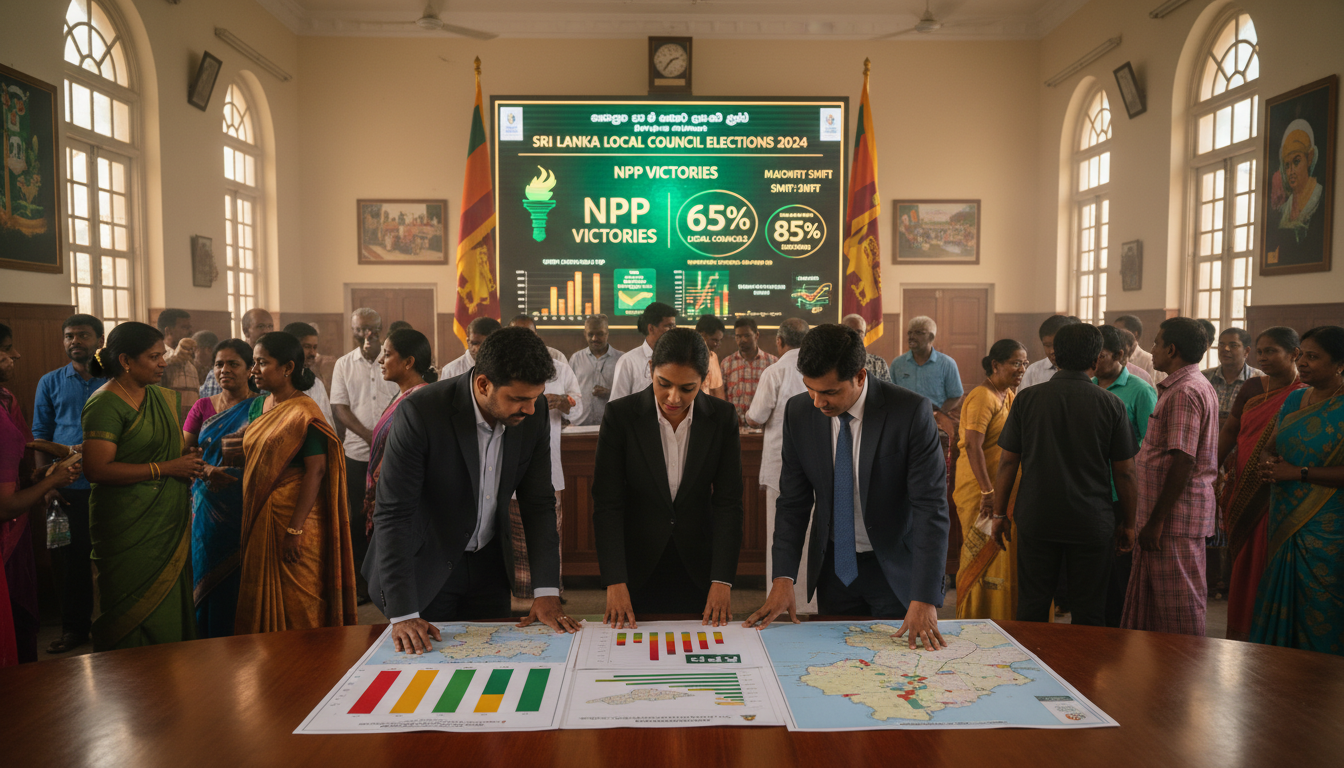
The 2025 Local Government Elections in Sri Lanka delivered a historic result. The National People’s Power (NPP) secured a commanding victory, winning control of 265 local government institutions.
This outcome represents a major shift in the nation’s political landscape. The party captured 3,927 seats with over 4.5 million votes nationwide.
The poll served as a critical barometer of public sentiment. It followed years of severe economic and political crisis felt by ordinary people.
Other major parties saw contrasting fortunes. The Samagi Jana Balavegaya (SJB) finished a distant second, securing just 12 local bodies.
The once-dominant Sri Lanka Podujana Peramuna (SLPP) and the United National Party (UNP) failed to win a single local government institution. This collapse underscores the scale of the change.
This article explores the factors behind this political earthquake. It will analyze the challenges revealed and the potential long-term impact on Sri Lankan democracy and grassroots governance.
Introduction: A Political Earthquake in Sri Lanka
Results from the 2025 local government polls triggered a fundamental realignment in Sri Lankan politics. This outcome is widely described as a political earthquake.
It upended hierarchies that had defined the island’s government for decades. The scale of change is unprecedented in recent history.
Local government elections serve as a critical barometer. They measure genuine grassroots support and party organization strength in towns and villages.
These polls test a party‘s connection to everyday issues. The results reveal where public trust truly lies.
The landscape once dominated by two major parties has been redrawn. The National People’s Power now holds clear ascendancy in most local councils.
This shift represents more than a simple change in administration. It signals a deep transformation in the political system itself.
President Anura Kumara Dissanayake’s leadership was central to this transformation. His party‘s message resonated powerfully with the electorate.
The victory raises immediate questions about its sustainability. How will the weakened traditional opposition react in the coming years?
The broader context of economic recovery shaped the public mood. Years of crisis created a strong demand for change across all areas.
This vote was a direct response to those unmet needs. Citizens used the ballot to express their priorities for local governance.
This section sets the stage for deeper analysis. The following parts will examine the decisive victory, the weakened opposition, and the strategies behind the result.
Decisive Victory: NPP’s Sweep of the 2025 Local Elections
The final tally of votes and seats paints a clear picture of a decisive political shift. The scale of this change is unprecedented in recent memory.
NPP’s Historic Seat and Vote Count
Official results from the 2025 local government elections show a landslide. The National People’s Power secured 3,927 local government seats nationwide.
This represents a historic high for the party. It garnered over 4.5 million votes from the electorate.
These numbers mark explosive growth in popular support. Compared to previous local election cycles, the increase in both seats and votes is dramatic.
The performance of other major groups highlights the scale of this victory. The Samagi Jana Balawegaya finished second with 1,767 seats.
The Sri Lanka Podujana Peramuna won 742 seats. The United National Party managed to secure 381 seats.
Regional Dominance Across Local Government Bodies
Winning 265 Local Government Institutions translates to direct administrative control. This means the party now oversees a vast network of local councils.
Control of a local government body involves managing key services. These include waste collection, road maintenance, and public utilities.
This geographical spread shows strength across much of the country. The results indicate a broad mandate from urban and rural areas alike.
Such widespread control establishes a powerful grassroots foundation. It provides a tested platform for future government elections.
The scale of this win in the 2025 local polls reshapes the political map. It gives national people power a formidable position in everyday governance.
The Weakened Opposition: SJB, SLPP, and UNP’s Performances
While one movement celebrated a historic triumph, the electoral map revealed deep struggles for its traditional rivals. The results forced a sobering reassessment of strength for Sri Lanka’s major political parties.
This analysis examines the performances that defined the weakened opposition. It explores what the numbers mean for the future of these groups.
SJB’s Distant Second Place Finish
The Samagi Jana Balawegaya (SJB) secured the position of primary opposition. Its final tally, however, highlighted a significant gap.
Led by Sajith Premadasa, the party won 1,767 seats nationally. This placed it a distant second, failing to mount a serious challenge to the frontrunner.
The outcome raises questions about the group’s strategy and connection with voters. For a national party aiming for higher office, this finish suggests a need for substantial rebuilding.
SLPP’s Dramatic Collapse at the Grassroots
The decline of the Sri Lanka Podujana Peramuna (SLPP) was stark. From being the ruling party just years prior, it secured a mere 742 seats.
This result signals a dramatic collapse of its grassroots machinery. The Lanka Podujana Peramuna‘s steep fall reflects a profound loss of public trust.
The election data shows the Podujana Peramuna base eroded significantly. Its performance indicates a deep crisis for one of the island’s once-dominant forces.
UNP’s Fading Relevance in Urban Centers
The United National Party (UNP) managed to secure just 381 seats. This historically low number reflects its diminishing presence across the country.
The United National Party‘s loss of influence in traditional urban strongholds was particularly telling. The Sri Lankan political landscape has moved beyond its former dominance.
This result for the united national group questions its future viability as a major player. It now occupies a marginal space in the national conversation.
Other significant parties recorded varied results. The Illankai Tamil Arasu Kachchi (ITAK) won 377 seats, while the Sri Lanka Muslim Congress (SLMC) secured 116.
The People’s Alliance and Sarvajana Balaya won 300 and 226 seats respectively. This comprehensive landscape shows where votes were distributed beyond the main contenders.
This factual post-mortem sets the stage for understanding the vacuum that was filled. The challenges of rebuilding for the opposition are now immense.
Understanding NPP’s Grassroots Appeal and Strategy
The massive shift in voter loyalty did not occur in a vacuum. It was driven by specific, identifiable factors at the local level.
This section examines the two primary forces behind the electoral numbers. It looks at leadership appeal and a fundamental change in public sentiment.
President Anura Kumara Dissanayake’s Leadership Role
The movement is led by President Anura Kumara Dissanayake. His leadership style became a central pillar of its grassroots appeal.
His public communication was direct and focused on economic issues. This resonated with voters experiencing hardship across the country.
Policy messaging emphasized systemic change and accountability. This contrasted sharply with the records of established political parties.
Perceived personal integrity was a key asset. Many citizens viewed him as a figure distinct from traditional political elites.
His background and narrative connected with ordinary people. This helped build genuine trust and support on the ground in many areas.
Shifting Voter Sentiment Against Traditional Parties
A powerful anti-establishment mood defined the election cycle. Voters expressed deep frustration with the major political parties.
This sentiment targeted the SLPP, UNP, and SJB. Blame was placed for years of economic mismanagement and corruption.
The winning party successfully positioned itself as the credible alternative. Its platform focused on change and fixing a broken system.
This strategic positioning filled a vacuum left by a weakened opposition. It channeled public desire for a new direction.
However, support at this level is not static. Recent co-operative society election results introduce a note of caution.
Defeats in key southern districts like Kelaniya and Homagama point to a challenge. A gap can emerge between reform rhetoric and everyday disillusionment.
This is especially true among the working-class base. It suggests that maintaining grassroots confidence requires delivering on promises.
The analysis provides context for the political shift. It balances the explanation of appeal with an objective look at emerging challenges.
Historical Parallels: Chelvanayakam’s Federalism and Grassroots Mobilization
Long before recent electoral shifts, another movement demonstrated the power of principled, local organization. The strategies of SJV Chelvanayakam and his Ilankai Thamil Arasu Kadchi (ITAK), or Federal Party, offer a historical case study.
This examination provides depth to the discussion of political mobilization. It shows that effective grassroots engagement has deep roots in the country‘s history.
SJV Chelvanayakam’s Political Journey and Principles
S.J.V. Chelvanayakam was an accomplished civil lawyer and King’s Counsel. He entered politics later in life, bringing a serious, principled demeanor to his work.
His early association was with the Tamil Congress. A profound split occurred over the 1948 Citizenship Act, which disenfranchised many Tamil people.
This principled stand led him to found the Federal Party in 1949. The new party was built on a platform of equality and federalism.
Chelvanayakam’s approach was firmly constitutional. He believed in using parliamentary debate and legal challenges to advance his party‘s goals.
His reputation for integrity became a core asset. It helped build genuine trust among his supporters over many years.
The Federal Party’s Non-Violent Mass Movements
Beyond the halls of power, Chelvanayakam mastered non-violent mass mobilization. He organized satyagraha campaigns and political pilgrimages.
These actions directly engaged the people in the north east and other Tamil-majority areas. They were powerful expressions of political will.
This strategy combined elite negotiation with direct public action. The famous Bandaranaike-Chelvanayakam (B-C) Pact of 1957 was one such high-level effort.
Authorities imprisoned and detained him multiple times for his activism. This only solidified his image as a committed leader.
The Federal Party’s work mobilized a community around core demands. It showed how a disciplined party could channel a population’s vote and voice.
Chelvanayakam’s legacy is a textbook example of sustained, principle-based mobilization. It highlights the enduring need to connect with citizens on the ground.
The Four Demands: Legacy and Contemporary Relevance
At the heart of decades of political negotiation lie four foundational demands articulated in the mid-20th century. These issues defined a major strand of Sri Lanka’s constitutional discourse for generations.
They were formulated by S.J.V. Chelvanayakam and his party, the Ilankai Thamil Arasu Kadchi (ITAK), or Federal Party. The demands sought to address fundamental inequalities within the political system.
Their legacy remains highly relevant today. They form a crucial historical backdrop for ongoing debates about power sharing and rights.
Citizenship, Language, Land, and Autonomy
Chelvanayakam’s framework consisted of four clear points. Each targeted a specific area of grievance for Tamil-speaking people.
- Restoration of Citizenship: This demand focused on hill country Tamils disenfranchised by the 1948 Citizenship Act. It called for restoring their right to vote and full civic participation.
- Language Parity: It advocated for equal status for the Sinhala and Tamil languages in administration and education. This was a direct response to the 1956 Sinhala Only Act.
- Cessation of State Colonization: The demand sought to halt government-sponsored Sinhalese settlement in Tamil-majority areas. It aimed to protect demographic patterns and land rights.
- Regional Autonomy: This called for the devolution of power to the Northern and Eastern Provinces. The concept of the north east as a traditional homeland was central to this territorial claim.

These points were not isolated. They formed an integrated platform for equality and self-determination within a united country.
The Federal Party, or Tamil Arasu party, successfully made these issues central to Tamil political identity. They mobilized people around these concrete goals for many years.
The B-C Pact and Unfulfilled Constitutional Promises
These four demands moved from protest to high-level negotiation. The most famous effort was the Bandaranaike-Chelvanayakam Pact of 1957.
Prime Minister S.W.R.D. Bandaranaike and Chelvanayakam reached this agreement. It addressed language parity, regional council powers, and land settlement.
The pact represented a classic attempt at elite consociationalism. It was a compromise between the central government and Tamil political leadership.
Strong opposition from Sinhala nationalist groups led to its abrogation. This pattern of agreement and reversal created deep distrust.
A later agreement with Prime Minister Dudley Senanayake in 1965 also saw only partial implementation. This history cemented a narrative of unfulfilled constitutional promises.
Elements of these demands were later addressed through other means. The 13th Amendment created provincial councils, offering a form of devolution.
Citizenship acts eventually restored rights to many plantation Tamils. Language provisions were also constitutionally recognized.
The most persistent and contentious issue remains land and settlement. This continues to be a flashpoint in the island’s politics.
This historical foundation is essential for understanding current debates. The performance and promises of any ruling body are still measured against this legacy of demands.
Cracks in the Foundation: Co-operative Election Setbacks
Electoral setbacks in co-operative society polls provide a critical counterpoint to the dominant narrative of triumph. These results expose a widening gap between government rhetoric and everyday reality.
The data reveals a significant shift in some traditional bases of support. This is particularly evident among working-class communities.
Defeats in Key Southern Districts like Kelaniya and Homagama
In recent co-operative society elections, groups backed by the ruling party suffered notable defeats. They lost at least nine out of fourteen contests.
Key losses occurred in politically significant southern districts. These included Kelaniya, Beruwala, and Homagama.
Such areas are often bellwethers for broader political sentiment. Defeats here signal a tangible shift on the ground.
The outcomes stand in stark contrast to the sweeping local government victory. They suggest political strength is not monolithic.
Erosion of Working-Class and Base Support
These co-operative election results point to specific grievances. Ongoing cost-of-living pressures are a primary concern for many voters.
There is also a perceived delay in delivering promised economic reforms. The very communities that propelled the current administration to power are showing impatience.
This trend serves as an important data point for assessing current popularity. It is a reality check on the government’s connection with its base.
The analysis suggests that maintaining support requires demonstrating tangible progress. Voters in these areas are expressing their priorities through these local elections.
These co-operative society results balance the narrative of overwhelming victory. They highlight emerging political challenges that must be addressed.
The Provincial Council Question: A Test of Democratic Commitment
The promise to revive a dormant tier of governance has become a litmus test for the current government‘s democratic principles. Provincial councils have not seen an election since 2018.
This creates a significant gap in the devolved system established by the 13th Amendment. For years, citizens in the provinces have been governed by unelected officials.
The issue now tests the ruling party’s commitment to its own pledges. It moves the discussion from local victories to a national constitutional duty.
NPP’s Pre-Election Promises to Hold PC Elections
During the campaign, the National People’s Power made a clear commitment. It promised to hold Provincial Council elections by early 2026.
This was framed as a key step to restore full democratic function. The pledge aimed to address a long-standing grievance in the country’s politics.
Voters saw it as a commitment to uphold institutional integrity. The promise was part of a broader platform for renewal and change.
Post-Victory Hesitation and Strategic Patience
Following the co-operative society election setbacks, enthusiasm has visibly diminished. Some leaders within the party now call for strategic patience.
They argue the focus must first be on economic development and reform. Holding provincial polls is suggested as a secondary priority for now.
This shift follows a familiar pattern. Previous governments used justifications like delimitation or constitutional review to postpone elections indefinitely.
The political calculus appears straightforward. After signs of grassroots erosion, the administration may fear another direct test of its popularity.
Such a delay would mean unelected governors continue to administer the provinces. This contradicts the spirit of devolution and the expressed will of the people.
The tension is between democratic promises and political pragmatism. The weakened opposition and civil society groups are watching closely.
This hesitation raises questions about the consistency of the commitment to devolution. It places the long-overdue provincial councils at the center of a democratic debate.
Constitutional Obligations: The 13th Amendment and Beyond
The foundation for elected provincial councils was laid in 1987, but the current reality starkly departs from that blueprint. This gap between law and practice defines a critical issue in the nation’s governance.
Understanding this requires a look at the constitutional bedrock. The 13th Amendment to the Sri Lankan Constitution established the Provincial Council system.
It remains the primary legal framework for devolving power. Its creation and intent are essential to grasp the current dilemma.
Devolution Framework and the Indo-Lanka Accord
The amendment was enacted following the Indo-Lanka Accord of 1987. This agreement aimed to address long-standing ethnic tensions through a measure of regional autonomy.
The constitutional change created nine provincial councils. These were designed as elected body for local governance.
Their powers include education, health, agriculture, and local planning. The goal was to share administrative control closer to the people.
This framework was a compromise within a unitary state. It intended to provide Tamil-speaking communities, particularly in the north and east, a voice in their own affairs.
The system represented a major shift in the country‘s political structure. It promised a new layer of democratic participation.
Current Administration by Unelected Governors
Today, this constitutional design is in suspension. The nine provinces are not run by the elected councils the law mandates.
Instead, they are administered by the President through appointed Governors. These officials are handpicked by the central government.
This creates an unconstitutional reality. Power is exercised by decree, bypassing the representative councils.
Consider a simple analogy. A Sri Lanka with only a President and no Parliament would be widely condemned as undemocratic.
Yet, this is the microcosmic situation in each province today. An unelected official holds executive power without a local legislature.
This administration-by-appointment particularly affects the Northern and Eastern Provinces. It directly undermines the devolution promised to Tamil-speaking people.
The delay in holding elections means this arrangement continues indefinitely. It is a clear deviation from constitutional norms.
The weakened opposition and civil society watch this situation closely. The status quo tests the commitment to the rule of law.
Framing this as mere political choice misses the point. It is a potential breach of the nation’s supreme law.
This objective explanation sets the stage for understanding legal challenges. The next section explores how courts might enforce these constitutional timelines.
Legal Avenues: Enforcing Election Timelines Through the Courts
When political will falters, the judicial system offers a constitutional path forward. The extended delay in holding provincial council elections may be resolved not through negotiation but by legal mandate.
This approach shifts the debate from strategy to obligation. It places the timeline for votes in the hands of the nation’s highest court.
Such a move would test the foundations of Sri Lankan democracy. It asks whether constitutional promises can be suspended indefinitely by any administration.
Potential Challenges by Opposition and Tamil Representatives
Key actors are positioned to initiate this legal process. National opposition parties have a direct interest in challenging the status quo.
A defeat in co-operative society elections does not remove their right to seek judicial review. They can argue that the continued postponement harms their ability to function and represent voters.
More significantly, Tamil political representatives from the North and East are likely petitioners. Figures like M.A. Sumanthiran have consistently advocated for the full implementation of the 13th Amendment.
For these leaders, the issue is not merely political. It is about the fundamental rights of their constituents to elected local governance.
Their argument would be powerful and simple. The constitutional framework for devolution is being rendered meaningless by executive inaction.
A coalition of petitioners could include civil society groups and affected citizens. This would demonstrate broad concern beyond partisan politics.
Breach of Article 154 and the 13th Amendment
The core of any legal challenge rests on specific constitutional provisions. Article 154 of the Sri Lankan Constitution is unequivocal.
It mandates that every province shall have a Provincial Council. The body must be elected by the people.
The 13th Amendment provides the operational framework for this system. Together, these laws create a non-negotiable duty to hold elections.
Constitutional experts widely view the current situation as a clear breach. The absence of elected councils for years violates the spirit and letter of the supreme law.
The legal process would likely involve a petition to the Supreme Court. Lawyers would seek a writ order compelling the Election Commission and the government to announce a poll date.
The court’s role is to interpret the constitution, not make policy. Its decision would focus on whether a fundamental duty has been neglected.
A successful challenge would leave the administration with no legal alternative. The government would be ordered to schedule the provincial council election within a defined period.
This presents the courts as a neutral mechanism for enforcing democratic rules. It moves the impasse from the political arena to the legal one.
The outcome would reinforce a critical principle. In a constitutional democracy, no party is above the foundational law of the land.
NPP’s Local Council Win: A New Chapter in Grassroots Politics
With unprecedented control over local councils, the ruling party faces the test of translating electoral success into effective governance. The sweeping victory in the 2025 local government elections cemented its status as the dominant force in community politics.
This control presents both immense opportunity and serious obligation. The administration must now deliver on promises made to millions of voters.
The results reshaped the entire landscape of municipal power. Traditional political parties were pushed to the margins across the country.
This analysis returns to the significance of that historic win. It integrates the complexities revealed by later events and data.
The mandate is clear, but maintaining it requires more than initial triumph. True grassroots engagement demands ongoing accountability and results.
Assessing the Long-Term Impact on Sri Lankan Governance
Control of hundreds of municipal body could fundamentally reshape service delivery in Sri Lanka. Local councils manage waste collection, road maintenance, and public utilities.
This direct administrative power touches citizens’ daily lives. How these services improve will measure the real impact of the political change.
Development planning may also see a shift away from centralized models. Local priorities could gain greater weight in national projects.
The network of political patronage built over years faces potential disruption. A new model of governance might emerge, less reliant on traditional party structures.
The question is whether this local dominance translates into sustainable national power. History shows that municipal control does not guarantee success in broader government elections.
The 2025 local results gave national people power a formidable platform. Converting that into lasting reform is the next challenge.
This requires building institutional capacity at the community level. It means training new officials and establishing transparent processes.
Redefining Grassroots Engagement Amidst Challenges
The recent co-operative society defeats revealed cracks in the foundation. These losses in key districts signal a gap between rhetoric and everyday reality.
Working-class communities expressed impatience with the pace of economic reform. This is the very base that propelled the administration to power.
True grassroots politics requires ongoing dialogue, not just initial electoral success. It demands listening to concerns about cost of living and service delivery.
The dilemma over provincial council elections presents another critical test. Postponing these votes contradicts the promise of renewed democracy.
Accountability through the ballot box is the core principle of people power. Avoiding further elections risks betraying the mandate given by the people.
The government must choose between short-term political caution and long-term democratic renewal. This choice will define its legacy more than any single victory.
The weakened opposition offers little external pressure. Therefore, the commitment must come from within the ruling party itself.
Grassroots engagement is not a one-time event but a continuous process. It involves showing tangible progress between election cycles.
The Sri Lankan public has demonstrated its willingness to reward performance and punish failure. The co-operative election results proved this clearly.
This section frames the central dilemma facing the administration and the nation’s democracy. The path forward requires balancing political control with democratic obligation.
Sri Lanka’s Democratic Crossroads: What Lies Ahead
The path forward for Sri Lankan democracy hinges on balancing electoral mandates with constitutional duties. The nation stands at a critical crossroads.
Decisions on issues like provincial council elections will define the quality of governance for years. The historic mandate from the 2025 local polls brings immense responsibility.
The administration must navigate economic pressures and maintain support on the ground. Fulfilling promises on devolution is crucial for all communities.
Further delays risk deepening ethnic mistrust and centralizing power. This contradicts the spirit of people power that fueled the victory.
The choices made by the government will be judged against its own pledges of democratic restoration. Opposition parties and citizens are watching closely.
In a democracy, power derived from the people requires continual validation. Transparent and timely electoral processes at all levels are essential for lasting legitimacy.