President Anura Kumara Dissanayake presented a crucial financial plan to the nation on November 7, 2025. This blueprint signals a clear strategic turn for the country.
It moves the focus from immediate crisis management toward long-term economic transformation. The core challenge is striking a delicate balance.
The plan must maintain strict fiscal discipline under the International Monetary Fund’s program. At the same time, it urgently needs to reignite domestic expansion and provide citizen relief.
This dual focus aims for macroeconomic stability through debt reduction and meeting revenue targets. It also seeks to invest in infrastructure, digital systems, and human capital development.
The overarching theme is moving “from crisis to transformation.” A key goal is rebuilding confidence among both local and international investors.
This context is shaped by recent severe economic challenges, including a major debt crisis. The ongoing IMF Extended Fund Facility program sets important parameters for the nation’s recovery path.
The blueprint sets an ambitious annual expansion target of 7%. Achieving this hinges on the successful implementation of its wide-ranging public investments and policy reforms.
The narrative is clear: fiscal consolidation and inclusive development are interconnected priorities. They are not opposing forces for this island nation’s journey toward resilient prosperity.
Sri Lanka’s 2026 Budget: A Strategic Pivot from Crisis to Transformation
A new financial roadmap unveiled this year shifts the country’s focus from survival to sustainable growth and structural change. This plan signals a fundamental reorientation in economic policy.
Presented by President Anura Kumara Dissanayake
The high-level presentation by the President, who also holds the finance portfolio, underscores a top-level commitment to change. It places economic overhaul at the very center of the national agenda.
This direct involvement aims to build political will for difficult but necessary policy shifts. It sends a clear message about the government‘s priorities.
Balancing IMF Mandates with Domestic Development Needs
The framework performs a delicate act. It must adhere to strict International Monetary Fund conditions for fiscal discipline.
Simultaneously, it addresses urgent domestic needs for job creation and public service improvement. This dual approach is termed “growth-friendly fiscal consolidation.”
It means raising revenue through tax reforms while protecting spending on health and education. The goal is to synchronize external program benchmarks with internal priorities.
For example, revenue measures are coupled with capital injections into roads and digital infrastructure. This strategy seeks to build public support for austerity.
The balanced plan aims to deliver tangible benefits from tough reforms. This is crucial for maintaining social stability and building long-term resilience.
Ultimately, it charts a course for inclusive development without derailing essential fiscal targets.
Anchoring Stability: Fiscal Discipline and Macroeconomic Targets
The latest financial blueprint establishes concrete numerical targets to anchor the nation’s economic recovery. This framework prioritizes strict fiscal discipline to build lasting macroeconomic stability.
It sets clear benchmarks for government spending, borrowing, and revenue collection. These targets are designed to guide the country out of its debt burden.
Primary Surplus and Debt-to-GDP Reduction Roadmap
A central goal is achieving a primary surplus. This means government revenue, excluding interest payments, exceeds its spending.
It is a key benchmark set by international lenders. Achieving it directly reduces borrowing needs and debt servicing costs.
The plan targets a deficit of 5.2% of GDP. More critically, it projects the debt-to-GDP ratio to fall to 95% by 2026.
The long-term aim is to reach 87% by 2030. This debt restructuring path is vital for sustainable growth.
Success here lowers risk premiums and frees up resources for public investment. It signals a credible commitment to creditors.
Key Tax Reforms: SSCL on Vehicles and VAT Standardization
Revenue mobilization is crucial. The tax-to-GDP ratio is expected to hit 14.8% in 2025.
Specific reform measures aim to broaden the base and simplify collection. The Social Security Contribution Levy (SSCL) on vehicles is now charged at the point of import, manufacture, or sale.
This shift aims to improve compliance and capture revenue earlier. Another major change replaces the Special Commodity Levy on imported coconut and palm oil with standard Value-Added Tax (VAT).
This standardization simplifies the system for businesses and consumers. Together, these changes aim to meet a revenue target of 15.3% of GDP by 2026.
Anti-Corruption Measures: E-Procurement and Digital Asset Management
The plan strongly links governance with fiscal health. A mandatory national e-procurement system will launch in 2026.
This digital platform aims to make government purchasing transparent and competitive. It is designed to reduce waste and opportunities for graft.
Alongside it, a digital public asset management registry will be established. This system requires officials to declare their assets electronically.
These measures increase accountability and public trust in how money is spent. Transparent systems are a foundation for effective discipline.
The Central Bank of Sri Lanka supports this consolidation by focusing on monetary stability. Its role in controlling inflation complements the government’s fiscal efforts.
This coordinated approach is essential for the overall economic environment. It helps create confidence for both local and foreign investment.
Fueling a 7% Growth Target: The Digital Leap Forward
The drive toward a 7% growth target is being fueled by unprecedented investments in technology and connectivity. This digital transformation is a central pillar for achieving ambitious annual expansion.
It positions the island for a modern, knowledge-based economy. The plan involves a multi-pronged strategy to upgrade digital infrastructure and public services.
These efforts aim to boost productivity across every sector. They also seek to create new opportunities for businesses and families.
A streamlined, transparent government apparatus is a key goal. The shift to fully digital operations is pivotal for this reform.
Establishing a Virtual Economic Zone for Tech Investment
A major policy tool is the creation of a Virtual Economic Zone (VEZ). This initiative is designed to attract foreign direct investment into high-tech industries.
The VEZ will focus on technology, software development, and business process outsourcing. It offers a regulatory and tax-friendly environment for global firms.
This zone operates without a physical boundary, leveraging digital connectivity. The goal is to make the nation a competitive hub for digital services.
Such investment is expected to have a significant positive impact on job creation and skill development. It builds confidence among international investors looking for a tech-ready workforce.
National Digital ID and Push for Cashless Government Payments
Improving citizen access and reducing fraud are critical objectives. A National Digital ID system is slated for rollout by March 2026.
This digital identity will serve as a single credential for all government and many private services. Its implementation plan focuses on secure, efficient enrollment.
The ID’s role includes:
- Streamlining service delivery by eliminating paperwork.
- Reducing identity fraud and benefit leakage.
- Enabling precise targeting of social welfare programs.
Alongside this, a major push for a cashless ecosystem within government transactions is underway. To encourage public adoption, fees have been eliminated for QR-based payments below Rs. 5,000.
This move makes small transactions more convenient and cost-effective. It is a practical step toward broader digital financial inclusion.
Boosting Connectivity: Tax Concessions for Telecom Infrastructure
Reliable digital connectivity is the foundation of this entire strategy. The plan includes concrete measures to bridge the digital divide.
A five-year tax concession is offered for the construction of digital communication towers. This incentive aims to accelerate private support for network expansion.
Furthermore, the installation of 100 new telecom towers nationwide is planned. These towers will improve coverage in underserved and rural areas.
Enhanced connectivity ensures that more citizens and businesses can participate in the digital economy. It directly supports the overall goal of inclusive economic growth.
In a forward-looking investment, Rs. 750 million is allocated for AI Service Centres. These centres will integrate artificial intelligence into public service delivery.
They aim to boost national productivity and improve administrative efficiency. Collectively, these digital initiatives are designed to reduce corruption.
They also enhance the ease of doing business. The ultimate aim is to create a more dynamic and resilient economy for all.
Investing in Human Capital: Health, Education, and Equity
Beyond infrastructure and digital systems, a core pillar of the economic strategy is investment in human development. This focus aims to build a healthier, better-educated, and more protected population.
Such investments are seen as fundamental for sustainable growth and social resilience. They address immediate needs while laying groundwork for long-term development.
Major Allocations for University Medical Faculties and Primary Care
The health sector receives significant financial support. A sum of Rs. 11 billion is allocated to medical faculties in state universities.
This major investment aims to expand the pipeline of future doctors and healthcare staff. It strengthens the nation’s long-term medical capacity.
Furthermore, Rs. 4.2 billion is earmarked for the Suwasariya Ambulance Service. This ensures critical emergency medical services remain robust and responsive.
An additional Rs. 1.5 billion is dedicated to nationwide Primary Healthcare Centres. This funding seeks to improve local access to basic preventative and treatment services.
Expanding Social Welfare: Thalassaemia Allowance and Disability Support
New welfare measures provide direct relief to vulnerable groups. A monthly allowance of Rs. 10,000 is established for thalassaemia patients.
This targeted financial aid helps families manage the high costs of ongoing treatment. It is a specific response to a pressing healthcare need.
Separately, Rs. 500 million is committed to establishing day-care centres for children with disabilities. This initiative offers crucial support to caregivers and promotes inclusion.
These efforts demonstrate how fiscal adjustment can protect social safety nets. They help meet social spending floors expected by international lenders like the IMF.
Increasing the Mahapola Scholarship and Public Sector Inclusion Quotas
In education, the Mahapola Scholarship sees a Rs. 2,500 increase. This boost directly assists students from low-income backgrounds with higher education costs.
It reduces the financial barrier to university, investing in the nation’s future skill base. Education is treated as a key driver of economic mobility.
A landmark policy mandates the reservation of 3% of all state sector recruitments for persons with disabilities. This move institutionalizes equity in public employment.
It represents a concrete step toward more inclusive employment practices within the government. The policy aims to tap into a wider talent pool.
Together, these health, welfare, and equity measures form an integrated social protection strategy. A healthier, more skilled, and inclusive workforce is considered essential for a resilient economy.
This aligns with the broader program of building long-term prosperity for Sri Lanka. It shows that disciplined fiscal management and human capital development can progress together.
Revitalizing Core Sectors: Infrastructure as a Growth Catalyst
The economic blueprint places a heavy bet on concrete and steel to drive its ambitious expansion goals. Massive capital expenditure is directed at physical infrastructure.
This spending is the engine for achieving high annual growth. It aims to improve logistics, connectivity, and national productivity.
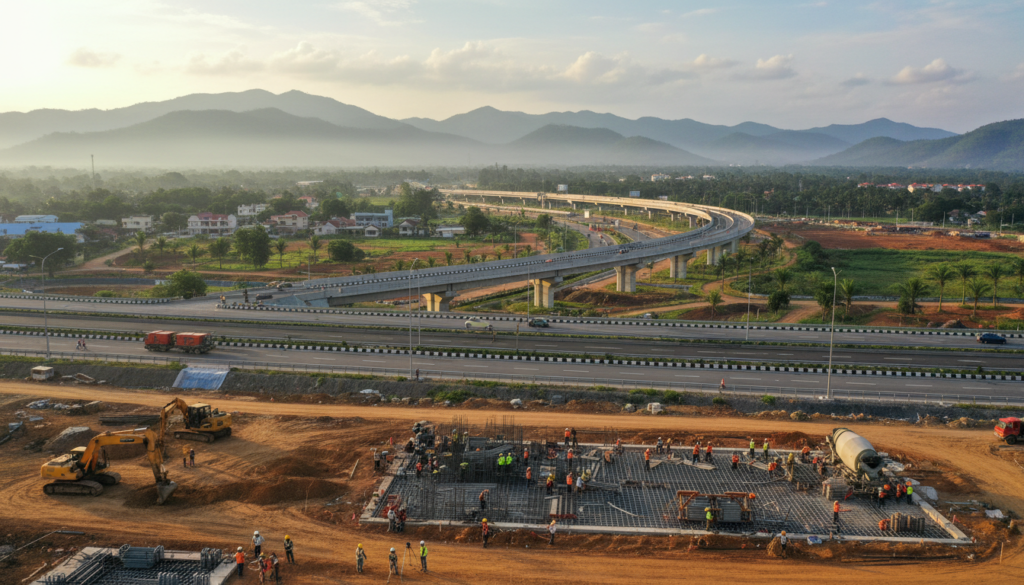
Investments target transport, agriculture, and rural development. The goal is to lay a stronger foundation for a competitive economy.
Accelerating Expressway Projects and Rural Road Development
A total of Rs. 34.2 billion is allocated for major road development. Key segments of the Central Expressway are a primary focus.
Funding also covers land acquisition for the Ruwanpura and Kurunegala-Dambulla expressways. Completing these corridors will slash transport costs for businesses.
They are designed to spur regional economic activity far beyond the capital. A parallel focus addresses rural needs.
Rs. 24 billion is set aside for village road construction. An additional Rs. 2.5 billion is for rural bridges.
These projects connect agricultural producers directly to markets. They are crucial for improving livelihoods outside urban centers.
Modernizing Public Transport with New Buses and Railway Units
Modernizing public transport is another key priority. The plan allocates Rs. 3.6 billion for 600 new long-distance buses.
This injection aims to improve the reliability and comfort of the Sri Lanka Transport Board fleet. For railways, Rs. 3.3 billion is committed.
It will fund five new Diesel Multiple Units (DMUs). These investments seek to improve commuter efficiency and reduce urban congestion.
Better public transit provides direct relief from high living costs. It also enhances access to jobs and services for millions.
Agricultural Boost: Irrigation Restoration and Livestock Self-Sufficiency Goals
The agricultural sector receives a strategic boost for climate resilience and output. Over Rs. 91.7 billion is dedicated to restoring vital irrigation infrastructure.
Major systems like Senanayake Samudraya and Gal Oya are included. A further Rs. 5 billion is for the Lower Malwathu Oya Multipurpose Project.
Reliable water access is critical for food security and farmer incomes. In livestock, a clear target is set for 75% self-sufficiency in cattle and swine by 2030.
This goal aims to cut expensive food imports. Targeted breeding programs will enhance domestic production.
Such measures support a broader significant growth strategy for the nation.
Collectively, these sectoral investments aim for job creation and import substitution. They demonstrate a tangible commitment to building from the ground up.
By strengthening the physical backbone, the plan seeks to create a more diversified and robust economic structure. This is essential for managing the national debt burden and improving the gdp outlook long-term.
Socio-Economic Upliftment: Wages, Housing, and Direct Relief
The economic plan directly tackles the daily financial pressures on citizens through targeted wage and housing initiatives. This focus aims to translate macroeconomic goals into tangible improvements for households.
It represents a conscious effort to cushion the impact of broader fiscal reforms. The measures seek to build public confidence in the government’s strategy.
Significant Salary and Pension Revisions for Public Servants
A collective Rs. 130 billion is allocated for public sector salary and pension revisions. This substantial investment underscores the state’s role as the nation‘s largest employer.
Of this total, Rs. 110 billion is for salary adjustments and Rs. 20 billion for pensions. The move is expected to boost morale and restore the purchasing power of government staff.
In a parallel policy, long-serving contract employees will receive permanent appointments. This regularization promotes fair labor practices and improves workforce stability.
It provides job security for thousands, strengthening the public service’s core.
The “A Place of Your Own” Housing Program for Low-Income Families
Housing receives direct support with Rs. 10.2 billion for the “A Place of Your Own – A Beautiful Life” program. This initiative directly addresses the shelter needs of low-income families.
It is a clear intervention to stimulate activity in the construction sector. An additional Rs. 15 billion is earmarked for an Urban Regeneration Project in Colombo suburbs.
This funding aims to improve living conditions and upgrade infrastructure in densely populated areas. These housing efforts align with wider efforts to address property rights and urban living.
Together, they provide crucial relief and promote inclusive urban development.
Landmark Increase in the Estate Workers’ Daily Wage
A historic increase targets a long-marginalized group. The daily wage for estate workers will rise from Rs. 1,350 to Rs. 1,750 by January 2026.
This 30% hike is one of the most significant direct relief measures in the plan. It has the potential to substantially reduce poverty and inequality within the plantation sector.
For many families, it means improved access to essentials like food, education, and healthcare.
These wage and housing supports are designed to ensure broader public buy-in for the fiscal strategy. They demonstrate that economic stability must improve citizens’ daily lives.
By addressing core needs, the budget aims to make the path to growth more inclusive and socially sustainable for Sri Lanka.
Revenue Mobilization and Tax Administration Reforms
The government’s revenue strategy aims to capture economic activity in both traditional and digital sectors. Strengthening the tax system is a critical step toward achieving long-term economic stability.
A robust domestic revenue stream is essential to reduce reliance on borrowing. It directly supports the broader goal of debt restructuring and meeting international program targets.
Broadening the Tax Base: VAT on Digital Services and Lowered Thresholds
A key policy extends the Value-Added Tax to digital services at an 18% rate. This move targets streaming platforms, software subscriptions, and online advertising.
It aims to capture revenue from the fast-growing digital economy. The change also seeks to level the playing field with traditional brick-and-mortar businesses.
Simultaneously, the VAT registration threshold is being reduced. This adjustment will bring many more small and medium-sized enterprises into the tax net.
Broadening the base is a fundamental reform for sustainable public finances. It reduces the burden on a narrow segment of existing taxpayers.
The Challenge of Raising Revenue to 15.3% of GDP
The plan sets an ambitious target for state revenue to reach 15.3% of gdp by 2026. Achieving this in a post-crisis economy presents a significant challenge.
There is a clear tension between the need for higher taxes and the potential dampening effect on business activity. Public sentiment regarding the cost of living adds another layer of complexity.
Successful revenue mobilization is non-negotiable for fiscal sustainability. It provides the funds necessary for public investment without exacerbating the debt burden.
This effort is closely monitored by the central bank as part of the overall fiscal discipline framework. A strong revenue performance supports monetary stability and investor confidence.
Impact of Simplified VAT (SVAT) Revisions on SMEs
Revisions to the Simplified VAT scheme aim to reduce fraud and close loopholes. However, these changes may increase the compliance burden for smaller companies.
Businesses must navigate new filing requirements and documentation rules. For some SMEs, this could mean higher administrative costs.
The measures are part of a wider push to improve tax governance and efficiency. Another example is the front-loading of the Social Security Contribution Levy on vehicles.
This levy is now imposed at the point of import or manufacture, not sale. It is designed to improve collection efficiency right at the border.
Together, these administrative reforms aim to build a more transparent and resilient revenue system. They are crucial for the success of the nation’s financial restructuring.
Public Sector Reform and State-Owned Enterprise Restructuring
Revamping the civil service and restructuring state-run companies are now seen as critical to fiscal sustainability. These interconnected reforms aim to boost the productivity of public spending.
The goal is to ensure taxpayer money generates real economic returns. This is a fundamental shift in how the government operates.
Recruiting 75,000 New Public Servants in Critical Roles
A major initiative plans to recruit 75,000 new public servants. This large-scale hiring targets specific, high-impact vacancies.
The focus is on technical, revenue collection, and law enforcement roles. These areas have suffered from critical capacity gaps for years.
Filling these positions is essential for improving state capability. It directly affects service delivery and the enforcement of laws.
A more professional administration can better execute complex policies. This commitment to staffing is a foundational support for all other development plans.
Addressing Loss-Making SOEs as an IMF Condition
Reforming State-Owned Enterprises (SOEs) remains a pressing need. Several large entities, like the national airline and energy utilities, drain the treasury.
Their chronic losses represent a massive subsidy from public funds. This has long been a drag on the national economy.
Restructuring these SOEs is a non-negotiable condition of the International Monetary Fund program. The process involves rigorous operational efficiency reviews and deep cost-cutting.
For some entities, strategic partnerships or even privatization are on the table. The objective is to stop the bleeding of public resources.
Legislative Frameworks for PPPs and Public Asset Management
To attract private capital, new laws are proposed for Public-Private Partnerships (PPPs). This framework is designed to bring investment into vital infrastructure projects.
It aims to ensure transparency and value for money in these deals. A separate legislative push focuses on public asset management.
This creates a formal registry and rules for managing state property. Together, these laws provide the legal backbone for modern public finance.
They are meant to reduce corruption risks and increase accountability. A clear legal environment also builds investor confidence.
These public sector changes are deeply connected. A capable, well-staffed administration is needed to manage complex SOE restructuring.
It is also essential for overseeing intricate PPP contracts effectively. The efforts collectively aim to improve governance and fiscal stability.
They move the system toward merit-based professionalism rather than subsidizing inefficiency. For Sri Lanka, this internal transformation is as crucial as any external budget target.
Alignment with the IMF’s Extended Fund Facility Program
The International Monetary Fund’s Extended Fund Facility program provides the essential framework for the nation’s fiscal strategy. This multi-year arrangement offers financial support and strict policy guidance.
Its continuation is non-negotiable for economic recovery. The program sets clear boundaries for debt reduction and revenue targets.
Successful reviews by the IMF executive board unlock crucial funding tranches. They also signal stability to global markets.
The current budget is designed to operate within these parameters. It reflects a careful balance between external conditions and domestic priorities.
Meeting Benchmarks on Primary Surplus and Social Spending
A core target is achieving a primary surplus of around 2.3% of gdp. This means state revenues must exceed non-interest expenditures.
Hitting this mark is a key performance criterion under the extended fund facility. It directly reduces borrowing needs and aids debt restructuring.
On social spending, milestones have already been met. Expenditure is projected to reach Rs. 230 billion, or 0.7% of GDP, by the end of 2025.
This floor protects vulnerable groups during fiscal adjustment. Meeting such benchmarks demonstrates commitment to the program.
It shows the government can deliver on its promises to both citizens and lenders.
Governance Reforms: Asset Declarations and Anti-Corruption Drive
Stronger governance is a pillar of the IMF agreement. An enhanced asset declaration system for officials is being implemented.
This registry will be publicly accessible, increasing transparency. A new legal framework, the Proceeds of Crime Act, strengthens anti-corruption measures.
These reforms aim to rebuild public trust in institutions. They address long-standing concerns about accountability.
The IMF executive board closely monitors progress in this area. Good governance is seen as foundational for sustainable discipline.
The IMF’s Emphasis on Growth-Friendly, Socially Sensitive Consolidation
The International Monetary Fund now advocates for a nuanced approach to fiscal consolidation. The philosophy is to make it growth-friendly and socially sensitive.
This means protecting capital investment and social safety nets even while cutting deficits. The latest financial plan attempts to embody this principle.
It allocates significant funds to infrastructure, health, and education. This strategy aims to cushion the public from the harshest effects of austerity.
Successful program reviews do more than release funds. They restore international investor confidence and facilitate the conclusion of external debt restructuring.
While the extended fund facility sets the rules, the budget reflects a national strategy. It works within those boundaries to pursue its own development goals.
The path forward requires strict adherence to the program. Yet it also demands smart choices to foster inclusive prosperity.
Navigating the Challenges: Execution, Transparency, and Public Burden
The ambitious vision of the nation’s financial plan now faces its most difficult phase: turning policy into practice. Its success hinges on navigating a complex web of administrative hurdles, maintaining public trust, and managing external pressures.
The central tension is clear. Authorities must maintain strict fiscal discipline under an international program while addressing growing citizen demand for cost-of-living relief.
The Critical Importance of Efficient and Corruption-Free Implementation
Several major obstacles threaten smooth execution. Bureaucratic capacity constraints are a primary concern.
The civil service must manage complex projects and new digital systems simultaneously. Potential resistance to reforms from within various sectors could also slow progress.
Perhaps the most persistent risk is corruption derailing projects and wasting public funds. The plan’s efforts to mitigate this are largely digital.
A mandatory national e-procurement system aims to make government purchasing transparent. A digital asset management registry for officials seeks to increase accountability.
These tools are designed to prevent the leakage of precious public resources. Their effective rollout is a non-negotiable foundation for everything else.
Balancing Austerity with Public Demand for Cost-of-Living Relief
Public fatigue with austerity and high taxes presents a significant social challenge. Maintaining reform momentum is politically difficult when immediate economic relief feels limited.
The wage hikes and housing support detailed earlier are direct attempts to address this need. They aim to cushion the impact of broader fiscal tightening.
Yet, the balance remains delicate. If revenue targets prove overly optimistic, a dangerous scenario could unfold.
Mid-year spending cuts or further tax hikes might become necessary. Such moves could stifle the very growth the plan aims to foster.
This would erode public confidence and make future adjustments even harder.
Ensuring Policy Continuity to Sustain Investor Confidence
For long-term recovery, policy consistency beyond political cycles is vital. Frequent reversals of tax or investment rules undermine the investor confidence needed for recovery.
Both local and foreign capital require a predictable environment. Sustained political will is essential to provide this stability.
External risks also loom large. The plan’s assumptions could be jeopardized by global economic slowdowns or commodity price shocks.
As noted in positive economic forecasts, such external factors require agile policy responses. Building economic resilience is key to weathering these storms.
The nation’s debt restructuring path adds another layer of complexity. Any deviation from fiscal targets could unsettle international creditors.
In conclusion, the blueprint’s transformative vision will only materialize through exceptional competence and integrity in implementation. Transparent execution, sustained political commitment, and a keen awareness of public sentiment are the indispensable ingredients for turning this ambitious roadmap into a reality of inclusive prosperity.
The Path Forward: A Blueprint for Resilient and Inclusive Prosperity
The true measure of this economic strategy will be its execution, turning policy documents into tangible improvements for citizens. This comprehensive blueprint seeks to balance immediate fiscal discipline with long-term investment in digital systems, infrastructure, and human capital.
Its integrated approach makes governance reforms central to effective resource use. These measures are not extras but essential for building public trust and resilience.
Success now depends entirely on implementation. It requires unwavering government commitment and vigilant oversight from civil society.
The coming years will judge the plan by tangible outcomes: higher growth, falling debt ratios, better living standards, and renewed investor trust. Faithful execution can start a new chapter of shared prosperity.
Ultimately, translating this complex framework into a better daily reality demands a collective national effort. That shared endeavor is the final, crucial step toward sustainable development and stability.