
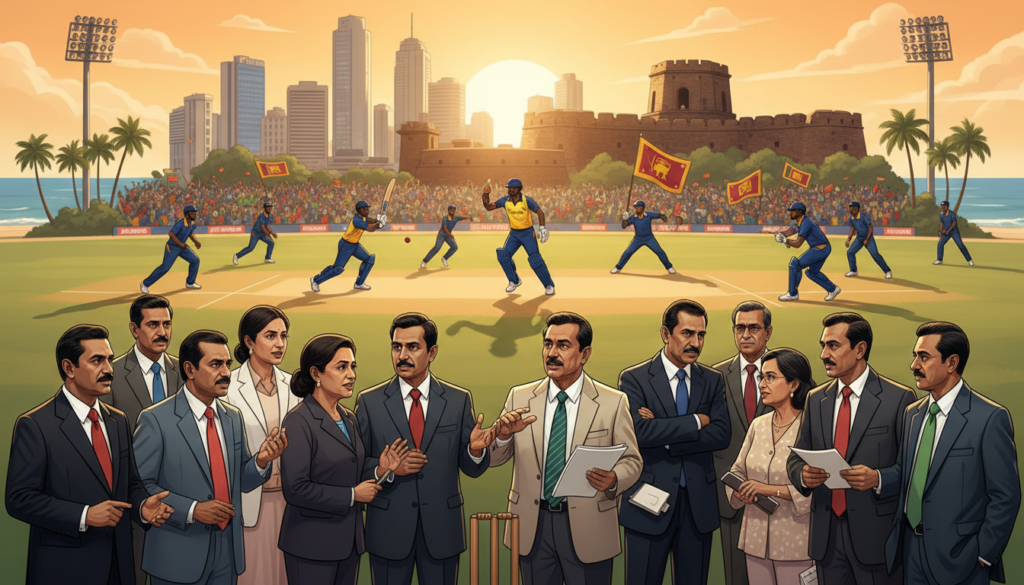
How a nation runs its most beloved sport can mirror its wider struggles. In Sri Lanka, the focus on sports administration reflects deeper national governance challenges.
The appointment of a new Transformation Committee has pushed this issue into the mainstream. Chaired by former minister Eran Wickremaratne, it signals a potential shift in culture.
This committee includes respected former players like Kumar Sangakkara, Roshan Mahanama, and Sidath Wettimuny. Legal and business professionals join them, tasked with structural reforms and improving transparency.
The national team’s performance has declined for over a decade. Many point to management failures within the sports body as a primary cause.
This mismanagement parallels larger institutional problems. Similar issues contributed to the country’s severe economic crisis in 2022.
The committee’s work is now a critical test. It asks if Sri Lanka can restore professionalism and trust in its public institutions.
This discussion comes during a period of national recovery. Efficient use of scarce resources is paramount. The way this sport is run serves as a microcosm of the broader fight for competent, integrity-driven leadership.
More Than a Game: Why Cricket Administration Mirrors Sri Lanka’s Governance Crisis
The journey of Sri Lankan cricket from global champion to underperformer tells a story larger than sport. The 1996 World Cup victory was a peak moment of national unity. It created profound pride across the island.
Today, that feeling has faded. The sport’s management is now viewed with widespread disillusionment. Many see it as a symbol of ineptitude and corruption.
This shift is not a coincidence. The sport’s decline mirrors the nation’s own path from post-war optimism to crisis.
From National Pride to Symbol of Systemic Failure
The problems within the cricket board are specific. They include financial leaks, a lack of public accountability, and political interference in selections.
These are not unique to sports. They reflect the same pathologies seen in national governance. It is a case of systemic failure.
Poor team performance and budget shortfalls are technical failures. They are directly linked to macro-level state failures. The responsibility for this spans the institution.
The board’s dysfunction is not an isolated sports story. It is a clear symptom of wider institutional decay. This decay affects every citizen’s life.
The 2022 Economic Collapse and the Weakening of Public Institutions
The 2022 economic breakdown was a turning point. It pushed most citizens into hardship and severely weakened public trust.
Faith in all institutions, including sports bodies, eroded. The country was left with a diminished capacity to manage anything, from hospitals to stadiums.
Scarce national resources cannot be wasted on incompetence in any sector. This makes the efficient reform of cricket administration a matter of economic necessity. Efficient use of funds is critical for broader economic recovery.
Ongoing challenges like natural disasters and global instability compound the difficulty. Rebuilding any institution, on the field or off, is now harder.
Fixing this popular game requires the same principles needed for national renewal. The essential pillars are transparency, accountability, and meritocracy. The current test is whether these principles can be applied.
The Historical Entanglement: How Politics Built and Burdened Sri Lankan Cricket
To understand today’s administrative challenges, one must look back at the sport’s foundational years under state patronage. The modern cricketing landscape was not born on the field alone. It was crafted in the halls of power, with lasting consequences.
This relationship has always been a double-edged sword. Political vision provided the platform for global success. That same involvement later created systemic dependencies and conflicts.
J.R. Jayewardene and Gamini Dissanayake: The Founders’ Political Vision
President J.R. Jayewardene, a former cricket board chairman, saw the game as more than sport. He viewed it as a tool for culture, diplomacy, and national identity. He entrusted Minister Gamini Dissanayake with a clear mission: elevate Sri Lankan cricket.
Their efforts culminated in a major diplomatic victory. Dissanayake successfully campaigned for Test status in 1981. His persuasive speech at Lord’s, backed by Pakistan’s support, secured Sri Lanka’s entry into the elite international cricket arena.
This achievement embedded the sport in the project of nation-building. The state’s emotional investment was profound. President Jayewardene declared public holidays after the country’s first Test win in 1985 and its Asia Cup victory in 1986.
Such acts fused sporting success with political capital. They showed how the government used the team’s triumphs to foster national pride. This period marked the conscious political construction of Lankan cricket as a symbol.
Class Warfare and the JVP’s Opposition to “Elite” Cricket
Not everyone celebrated this state-sponsored rise. Opposition groups, notably the Janatha Vimukthi Peramuna (JVP), launched fierce criticism. They framed cricket as a “white man’s game” and an elitist diversion.
This backlash reflected deep class tensions. The sport was seen as the domain of Colombo’s privileged English-speaking schools. It was criticized for ignoring the people’s pressing economic woes.
The JVP and leftist parties argued it served as a political opiate. During the violent JVP insurrection from 1988-89, no cricket was played. This period highlighted how the sport could become a target in broader societal conflict.
The criticism was about more than sports. It was a challenge to the political order itself. It revealed a society divided along class lines, with cricket caught in the middle.
Premadasa’s Democratization and the Unifying Power During War
President Ranasinghe Premadasa recognized these dangerous divisions. His response was a strategic democratization of sports. He sought to balance cricket’s perceived elitist dominance.
He built the R. Premadasa Stadium in a working-class area of Colombo. He actively promoted athletics and football to broaden the national sporting culture. This was a direct political effort to make sports more inclusive.
An ironic unity emerged during the ethnic civil war. Even the Liberation Tigers of Tamil Eelam (LTTE) put up screens in the North. They cheered for the national team, especially during the 1996 World Cup.
For a time, the cricketing arena temporarily transcended bitter political divisions. It showed the sport’s unique, if fragile, power to unify.
This complex history is essential to untangling today’s governance knots. The leadership that built the modern international cricket identity also burdened it. The politics that provided lift-off later became a weight.
Understanding this past is key. The current challenges faced by cricketers and administrators are not new. They are deeply rooted in the sport’s politically shaped origins.
A New Committee and a Test of Bipartisan Governance
The creation of the Transformation Committee is more than a sports story. It is a litmus test for political cooperation.
This move places the reform of a major national institution under a unique microscope. The focus is on whether rival parties can collaborate for the common good.
Eran Wickremaratne and the “Transformation Committee”: A Profile in Integrity
Chairing this effort is Eran Wickremaratne. He is a professional administrator known for financial integrity.
His public career has no allegations of corruption. This clean record makes him a credible choice to lead sensitive reforms.
The committee’s mandate is specific and demanding. It must introduce structural changes to Sri Lanka Cricket.
Its core tasks focus on improving two pillars:
- Introducing greater transparency in financial and operational matters.
- Establishing clear lines of accountability for decisions and performance.
The group includes former star cricketers and experts. Their collective responsibility is to restore professional standards.
Wickremaratne’s leadership is central to this mission. His reputation is the committee’s foundation for public trust.
The Significance of Reaching Across the Political Aisle
The appointment carries major political weight. The ruling NPP government chose an figure associated with the opposition SJB party.
This is a rare departure from appointing only loyalists. It signals that national priority tasks may require cross-party expertise.
The move answers long-standing civic demands. Many citizens have called for more inclusive governance, especially on issues of clear national interest.
Reforming the sport’s administration is one such issue. The country cannot afford continued failure in this high-profile area.
However, the reaction from Wickremaratne’s own party was negative. The SJB objected and asked him to resign his membership.
This highlights a tension in politics. The principle is that skilled individuals can serve national reform temporarily, without implying partisan control.
Putting the national team and its structure above party loyalty is the test. It checks if the system can value competence over allegiance.
Facing Down Sectarian Attacks and Communal Politics
The committee faces another, more disturbing challenge. An insidious sectarian campaign has emerged against it.
This rhetoric is based on the religious affiliation of some members. It seeks to undermine their work with divisive language.
Such attacks contradict the plural reality of Sri Lanka. They also ignore the universal desire for success in this beloved game.
The government has pledged to protect equal rights. It stated it will not permit discrimination against the committee.
This stance aligns with recent public sentiment. Messages of unity, like large international peace marches, have received positive responses.
The committee’s challenge is now twofold. It must reform a broken sports body while resisting politically and communally motivated attacks.
Its ability to operate independently will be closely watched. This will be a direct measure of whether the island nation can practice the bipartisan cooperation it often preaches.
The time for change in Lanka Cricket is now. The process itself, led by this committee, will reveal much about the state of national administration.
Restoring the Pitch: Cricket Reform as a Blueprint for National Renewal
The true measure of this reform initiative will be its legacy beyond the boundary. Fixing the sport’s administration is intrinsically linked to healing a facet of national identity.
This committee appointment is a first step, not a guarantee. The island nation has fewer resources and deep institutional flaws. The crucial principle demonstrated is selecting expertise based on merit and integrity over party loyalty.
If successful, this model could provide a blueprint. Temporary, bipartisan expert panels might diagnose problems in other sectors. The country’s recovery is a collective effort, requiring support from all sides.
Public patience is vital. The sri lankan team once fostered unity and pride, especially during the 1996 world cup. Restoring that spirit is about more than success in the game. It is about applying lessons of competent governance for a more stable future.