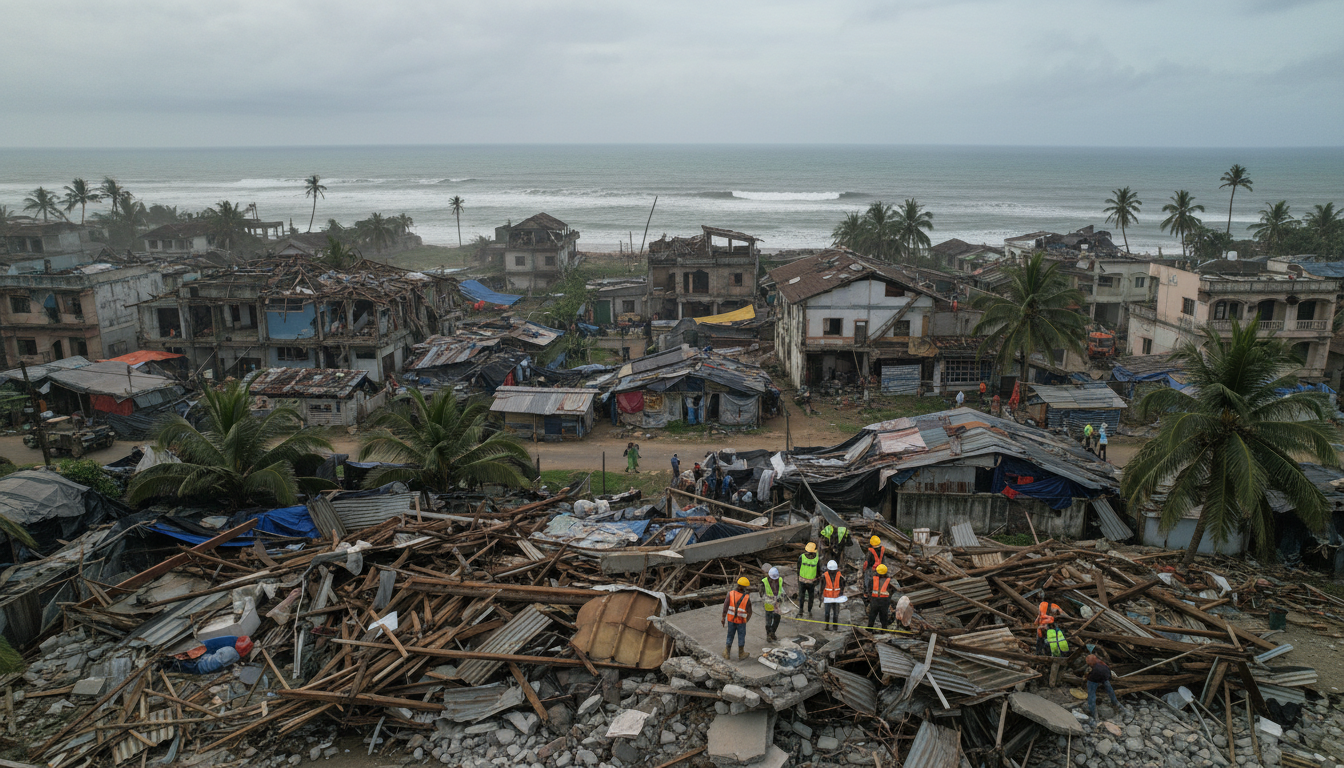
A powerful storm recently struck the island nation, leaving a trail of profound destruction. The event, named Cyclone Ditwah, is now considered one of the most severe natural disasters in recent memory. It tested the nation’s resilience and created an urgent national rebuilding challenge.
The economic toll is staggering. A World Bank report estimates the total damage at $4.1 billion. This figure represents about 4% of the country’s annual economic output. The scale highlights the event’s massive impact on the national economy.
In response, authorities announced a major financial plan. A domestic program worth Rs 1.2 trillion will be funded from the Treasury. This is supported by an additional $500 million in pledged international aid. This dual-track approach aims to fuel the extensive recovery effort.
The central theme of this national mission is infrastructure rebuilding. Restoring roads, power, and water systems is critical for returning to normal life. Key players include the government, global financial institutions, and local communities. This article details the damage, the plans, and the road ahead.
Introduction: A Nation Confronts Billions in Damage
The immediate aftermath revealed a crisis of immense proportions, touching every corner of the country. What began as a weather system escalated into a full-scale national disaster. The storm’s fury left a landscape transformed by flooding, landslides, and structural ruin.
Tens of thousands of people were forced from their homes. Local communities, the bedrock of social life, were fractured. This human toll defined the early chaos and pointed toward a long road to recovery.
The scale of the destruction triggered a formal emergency declaration. It demanded a massive, coordinated response from the state and aid agencies. The primary goal shifted instantly to saving lives and providing immediate relief to affected families.
In this context, the term “damage” expanded far beyond broken buildings. It came to represent profound social and economic needs. The crisis created urgent requirements for shelter, clean water, medical care, and food security.
The impact was not evenly spread. Early assessments showed a stark geographical divide. Districts like Kandy, Puttalam, and Badulla bore a disproportionate share of the loss. These three areas alone accounted for nearly 40% of the national losses.
This uneven devastation hinted at deeper vulnerabilities. It set the stage for a complex, multi-year rebuilding mission. The World Bank cautioned that the direct damage figure was just the starting point. Total economic losses would climb much higher when accounting for reconstruction costs and indirect impacts.
The island nation now faced a dual challenge. It had to manage the urgent humanitarian disaster while planning for a sustainable future. The following sections detail the staggering financial toll and the broken systems that must be restored.
The Staggering Toll: $4.1 Billion in Direct Losses
The financial magnitude of the catastrophe has been formally assessed, revealing direct losses in the billions. This figure provides a crucial baseline for all recovery planning and international funding discussions.
World Bank GRADE Report Sets the Baseline
The world bank provided the authoritative damage estimate. Its Global Rapid Post-Disaster Damage Estimation (GRADE) report is a standard tool.
This methodology allows for swift assessments after a major event. It focuses on immediate physical destruction to assets and property.
In clear terms, direct losses mean the cost to replace or repair what was broken. This includes roads, buildings, and utilities smashed by the event.
From Direct Damage to Total Reconstruction Costs
The $4.1 billion figure is just the starting point. Experts apply a global multiplier to estimate full rebuilding expenditure.
Total reconstruction costs could range from $7 billion to $10 billion. This is 1.75 to 2.5 times the direct physical damage.
This gap exists because rebuilding is more complex than simple repair. It involves design, logistics, and modernizing systems.
Indirect impacts amplify the initial disaster. Disruptions to supply chains and lost livelihoods create secondary economic losses.
The massive bill presents a serious finance challenge for the country. It must balance this need with other fiscal priorities.
International funds will be vital. The institutions that provided the assessment are also key partners for funding the long recovery.
Physical infrastructure bore the brunt of these direct losses. The next section details the broken systems that must be restored first.
Infrastructure Bears the Brunt of the Blow
The country’s backbone of development, its physical networks, suffered the most severe and costly impact. Official estimates placed the financial damage to this sector at a staggering $1.7 billion.
This figure represents about 42% of all direct losses from the event. Restoring these foundational systems became the paramount priority for national recovery.
Roads and Bridges: Vital Links Severed
The storm’s fury fell heavily on the transport network. Assessments confirmed about 247 kilometers of main national roads were heavily impaired.
More critically, 40 bridges were completely destroyed. These failures turned vital corridors into dead ends, severing connections between regions.
Railway Network Brought to a Standstill
The rail system experienced near-total paralysis. Reports indicated 70% of the network was rendered unusable.
This halt stopped all passenger and freight movement across major lines. It removed a key alternative for moving people and goods when roads failed.
The Cascading Impact on Supply Chains and Relief
The collapse of transport infrastructure triggered a chain reaction of secondary crises. Isolated districts could not receive emergency aid or evacuate the injured quickly.
The breakdown crippled supply chains for essential goods like food, fuel, and medicine. This loss of access dramatically worsened the humanitarian situation on the ground.
Economically, the damage meant a direct setback for ongoing development projects and daily commerce. Repairing these networks is the essential first step to overcoming the broader disaster.
Housing and Communities Shattered
Beyond the economic figures lies a deeply personal crisis of shattered homes and disrupted daily life. The event’s toll extended forcefully into the residential and social spheres where people live.
Thousands Displaced as Homes Destroyed
Housing losses reached a staggering $985 million. This sum represents about 24% of all direct damage from the disaster.
More than 6,000 homes were completely leveled. An additional 112,000 dwellings suffered partial damage.
These numbers translate into a tangible crisis for countless families. Suddenly, thousands found themselves without safe shelter, forced to rely on relatives or emergency centers.
The hardship was compounded by failures in local systems. Collapsed water supply lines and power outages turned damaged neighborhoods into uninhabitable zones.
Critical Services: Schools and Hospitals Damaged
The destruction also targeted vital social institutions. Over 1,000 schools and more than 100 health facilities were affected.
This damage caused a direct interruption of essential services. Classrooms stood empty, halting education. Clinics and hospitals struggled to function, limiting access to medical care.
The loss of these buildings struck at the heart of communities. Schools and hospitals are more than just structures. They are central pillars of neighborhood life and social stability.
In response, authorities initiated immediate relief. Measures included cleanup operations and temporary resettlement allowances for affected families.
These steps provide a crucial bridge. They address urgent needs while longer-term housing solutions are developed.
The central challenge is clear. Recovery must focus on rebuilding resilient communities, not just constructing individual houses. It requires restoring the social fabric that holds neighborhoods together.
Agricultural Heartland Devastated
The agricultural sector, a cornerstone of the national economy and rural life, faced catastrophic devastation. Official estimates placed direct damage at $814 million. This sum represents roughly 20% of all losses from the event.
This blow struck at the heart of the country‘s food production and rural employment. Recovery here is vital for overall stability and development.
Paddy Fields and Livestock Losses
Crop lands bore the initial fury. About 100,000 hectares of paddy were completely destroyed. An additional 150,000 hectares suffered significant damage.
This rendered vast stretches of fertile farmland unusable for the coming season. The impact on rice production, a national staple, was immediate and severe.
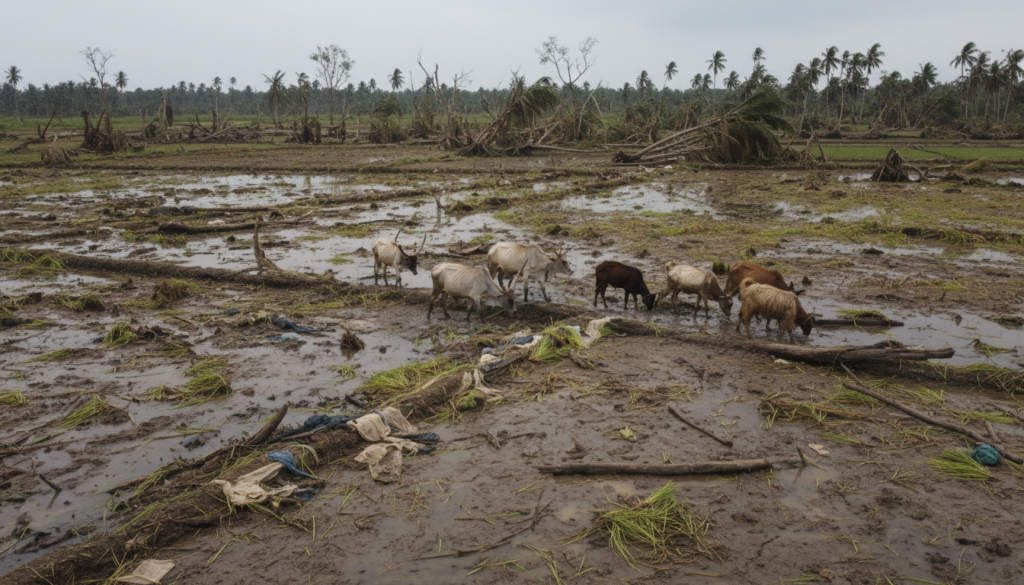
Livestock losses compounded the crisis. Tens of thousands of cattle perished. Nearly 3 million chickens were also lost.
For farming families, these animals represent crucial savings and income sources. Their loss created a deep financial hole for rural communities.
Threats to Food Security and Rural Livelihoods
The combined ruin of crops and animals raised acute risks. National food security faced a direct challenge. Local markets anticipated supply shortages and price increases.
Already vulnerable rural districts were hit hardest. In these areas, farming is often the primary economic activity. The event threatened to deepen poverty across entire district regions.
In response, authorities initiated compensation payments to affected farmers. This immediate relief aimed to provide a financial bridge. It helped cover basic needs and some restart costs.
Long-term recovery, however, requires more than just replacement. It demands building greater resilience into the agricultural system.
This includes investing in improved water management and climate-smart practices. The goal is to protect farmers’ livelihoods against future shocks.
The health of this sector is tied directly to the nation’s broader development trajectory. Rebuilding it stronger is essential for sustainable growth.
An Uneven Impact: Mapping the Hardest-Hit Districts
The path to rebuilding must account for a critical fact: the burden of loss was distributed very unevenly across the country. A detailed geographical breakdown reveals pockets of extreme devastation alongside areas that sustained less severe blows.
Kandy, Puttalam, and Badulla Account for 40% of Losses
Three specific regions absorbed a massively disproportionate share of the financial hit. The central district of Kandy suffered direct losses estimated at $689 million.
The coastal district of Puttalam recorded $486 million in damage. In the Uva Province, Badulla’s losses reached $379 million.
Together, these three districts accounted for almost 40% of the nation’s total direct losses. This concentration created localized crises that demanded urgent, targeted attention from relief agencies.
Total Exposed Value (TEV): Why Poorer Areas Suffered More
To understand the true depth of the crisis, experts look beyond raw dollar figures. They use a metric called Total Exposed Value, or TEV.
TEV measures the total worth of all assets in a district before the disaster. It shows what percentage of a region’s wealth was wiped out.
This analysis reveals a stark inequality in impact. A wealthy commercial hub like Colombo lost a smaller fraction, just 0.12%, of its massive asset base.
In contrast, a poorer northern district like Vavuniya lost 2.08% of its total exposed value. This represents a much more devastating blow to its limited capital.
Pre-existing economic conditions and available development space heavily influenced this outcome. Regions with weaker buildings, less robust infrastructure, and lower incomes were inherently more vulnerable.
This disparity presents a core challenge for equitable recovery. Local governance bodies will be crucial in assessing these nuanced needs.
A single, national recovery plan may fail to address the specific gaps in the hardest-hit districts. Effective rebuilding requires resource allocation that recognizes these profound local differences.
The Government’s Rs 1.2 Trillion Recovery Blueprint
To meet the colossal cost of reconstruction, authorities have crafted a domestic funding strategy centered on a massive treasury reserve. This blueprint outlines how the state will pay for its share of the national effort.
President Anura Kumara Dissanayake confirmed the plan’s scale. Approximately Rs 1.2 trillion will be allocated from the Treasury’s cash buffer.
This reserve acts as the nation’s fiscal savings account. Using it provides immediate liquidity without needing new loans for initial expenditure.
Drawing from the Treasury’s Cash Buffer
Tapping this buffer is a strategic finance decision. It allows the government to launch urgent projects without delay.
Officials emphasize this is a controlled use of existing resources. The move is designed to maintain stability in the broader economic system.
This domestic funding source complements international aid. Together, they form the complete financial architecture for the recovery.
A Phased Three-Year Plan Through 2028
Deputy Treasury Secretary A. K. Seneviratne detailed the timeline. The work will unfold in phases, extending through 2028.
The plan has three clear stages:
- Immediate Relief (Late 2025-2026): Focus on clearing debris, restoring basic access, and providing temporary shelter. Parliamentary approvals are targeted for November 2025.
- Core Reconstruction (2026-2027): Large-scale rebuilding of roads, bridges, utilities, and permanent housing.
- Resilience Building (2027-2028): Investing in stronger designs and development practices to mitigate future disaster risks.
This structure aims to transition from emergency response to sustainable recovery.
Navigating Fiscal Targets and Spending Ceilings
The massive spending creates a tension with pre-existing fiscal rules. Officials expect necessary costs to temporarily breach the 13% primary spending ceiling in 2025.
This is viewed as an unavoidable exception. The goal is to return to fiscal limits by 2027.
To manage the process, the government will use supplementary budgets and reallocate other funds. Recent tax reforms are also expected to generate revenue that can help offset some costs.
The blueprint represents a major test. It challenges the state to execute a vast program while upholding long-term fiscal discipline.
International Partners Mobilize $500 Million in Support
Multilateral lenders and aid agencies assembled a critical funding lifeline to address urgent post-disaster needs. This external support complements the nation’s own substantial financial plan.
International donor agencies committed a total of $500 million. This collective pledge is a cornerstone of the overall response strategy.
IMF’s Rapid Financing Instrument Addresses Balance-of-Payments Needs
The International Monetary Fund (IMF) approved a swift disbursement of $206 million. This capital came through its Rapid Financing Instrument (RFI).
The RFI is designed for urgent situations. It helps countries tackle immediate balance-of-payments pressures caused by a major disaster.
This finance helps stabilize the national budget. It covers essential imports and supports currency stability during the crisis.
World Bank and ADB Activate Emergency Funds
Other key institutions also moved quickly. The World Bank activated $120 million from emergency components within existing projects.
This mechanism allows for very fast release of funds. The money can be redirected to pressing recovery tasks without lengthy new approvals.
The Asian Development Bank (ADB) joined this coordinated effort. Along with other partners, it pledged around $500 million in total funding through 2026.
These emergency commitments are vital. They provide the immediate liquidity required to launch reconstruction projects.
The Strategic Use of Concessional Credit vs. Grants
A critical detail defines this international aid. The vast majority is structured as concessional credit, not outright grants.
Concessional loans have very low interest rates and long repayment periods. They are softer than commercial terms but still create future debt obligations.
This approach has clear strategic implications:
- Immediate Benefit: It provides the government with large, accessible cash flows to start work now.
- Long-Term Cost: The loans must be repaid, adding to the nation’s future fiscal burden.
The role of these international agencies extends beyond money. They bring technical expertise and project oversight to ensure effective use of funds.
The World Bank and ADB, for instance, often guide engineering standards and procurement processes. This coordinated external response is a crucial supplement to domestic treasury resources.
It enables a faster start to recovery. The trade-off is a more complex debt profile once the rebuilding is complete.
Rebuilding Sri Lanka’s Ravaged Transport Network
The Road Development Authority now confronts a defining challenge: restoring vital connections at a cost far exceeding initial losses. Getting the country moving again is the first, non-negotiable step in the wider recovery mission. This effort requires a massive, focused push on broken road and rail links.
Transport access is the foundation for all other activities. Without it, delivering construction materials to rebuild homes or getting crops to market becomes impossible. The scale of this task defines a primary logistical and financial hurdle.
RDA’s Rs 190 Billion Road and Bridge Restoration Challenge
Officials confirmed the Road Development Authority incurred a loss of approximately Rs. 75 billion. The price tag for comprehensive restoration, however, is set at a staggering Rs. 190 billion.
This gap exists because rebuilding is more than simple repair. The event damaged 316 roads and 40 bridges under the RDA’s care. Full restoration involves modernizing designs and using more resilient materials.
The figures illustrate a harsh reality. The cost to build back properly is often more than double the value of what was destroyed. This is a central financial tension for the entire reconstruction program.
Assessing the Full Scope: Local Roads and Railways
The RDA’s numbers only cover national highways and major structures. A full assessment must include thousands of kilometers of local municipal roads. These secondary networks are crucial for last-mile connectivity to villages and farms.
Their damage severely limits community access. The railway network also suffered a near-total standstill, as noted in earlier reports. This combined failure of road and rail crippled the movement of people and goods.
Separate assessments and funding streams are needed for these systems. Local government bodies and the railway department face their own complex projects. Restoring this layered transport infrastructure is a multi-agency effort.
Seeking Funding from the World Bank and Other Institutions
To bridge the massive funding gap, authorities are tapping international sources. Officials expect to obtain a Rs. 2 billion loan from the World Bank specifically for transport work.
This loan is a case study in recovery finance. It is expected to be concessional credit, with favorable terms. The process involves detailed project proposals and strict oversight.
The search for capital extends to other institutions like the Asian Development Bank. These funding partnerships are essential. They provide the upfront cash required to start large-scale construction without draining domestic reserves.
Sri Lankan engineers and construction firms will lead the physical work on the ground. Their role is critical in turning financial commitments into rebuilt asphalt and concrete. This local capacity is a key asset for the nation.
Success here directly supports long-term economic development. Reliable transport networks boost trade, tourism, and regional connectivity. Rebuilding this infrastructure stronger is an investment in future stability and growth.
Restoring Essential Utilities: Power and Water
State-owned utility companies are now tallying immense financial losses from the widespread destruction of critical systems. Reliable electricity and clean drinking water are fundamental for public health and restarting the economy.
Their rapid restoration is a top priority for the national government. Without stable power and water supply, schools cannot reopen and factories remain idle.
CEB’s Rs 20 Billion Loss and the Debate Over Loans vs. Grants
The Ceylon Electricity Board (CEB) reported a massive financial hit. Its direct losses are estimated at approximately Rs. 20 billion.
A smaller distributor, the Lanka Electricity Company, lost an estimated Rs. 252 million. This damage includes shattered transmission lines, poles, and substations.
Discussions are underway for a World Bank loan to finance the CEB’s repair work. This approach highlights a central issue in recovery financing.
Should utility restoration be funded by loans or grants? Loans must be repaid, often leading to higher consumer tariffs later. Grants provide support without adding debt.
The choice has direct consequences for household budgets. Many argue that essential public services deserve grant-based support to avoid burdening citizens.
National Water Supply Board Damage and ADB Grant Plans
The National Water Supply and Drainage Board faced its own crisis. It recorded losses of Rs. 5.6 billion from broken pipelines and treatment plants.
In contrast to the CEB, this institution is pursuing a different path. Based on committee advice, arrangements are being made to obtain an Asian Development Bank (ADB) grant.
This grant funding would cover restoration costs without creating a loan obligation. Progress is already visible on the ground.
Officials report that 156 damaged water supply schemes have been restored. This work reconnected communities to clean sources.
The different approaches for the two state institutions reflect a practical debate. It centers on how to balance urgent needs with long-term financial sustainability.
The core challenge remains clear. The nation must rebuild these essential services quickly. Yet it must do so without placing an unbearable cost on the people who depend on them every day.
The Road Ahead: Execution, Sustainability, and Resilience
Economists highlight that delivery, not design, often becomes the critical hurdle in post-disaster reconstruction. The challenge now is turning detailed plans into on-the-ground results for affected communities.
Sustainability is a key issue. As analyst Raj Prabu Rajakulendran notes, a recovery financed heavily through concessional loans creates pressure in a tight fiscal space. The government must balance urgent rebuilding with long-term debt management.
This period is also a crucial opportunity. The nation can integrate climate resilience into rebuilt systems, strengthening disaster governance. The goal is to “build back better,” protecting future development.
The process must be equitable, addressing the uneven impact on districts. True recovery looks beyond immediate projects toward stable and inclusive growth. Learning from this event is essential for building a more resilient Sri Lanka.